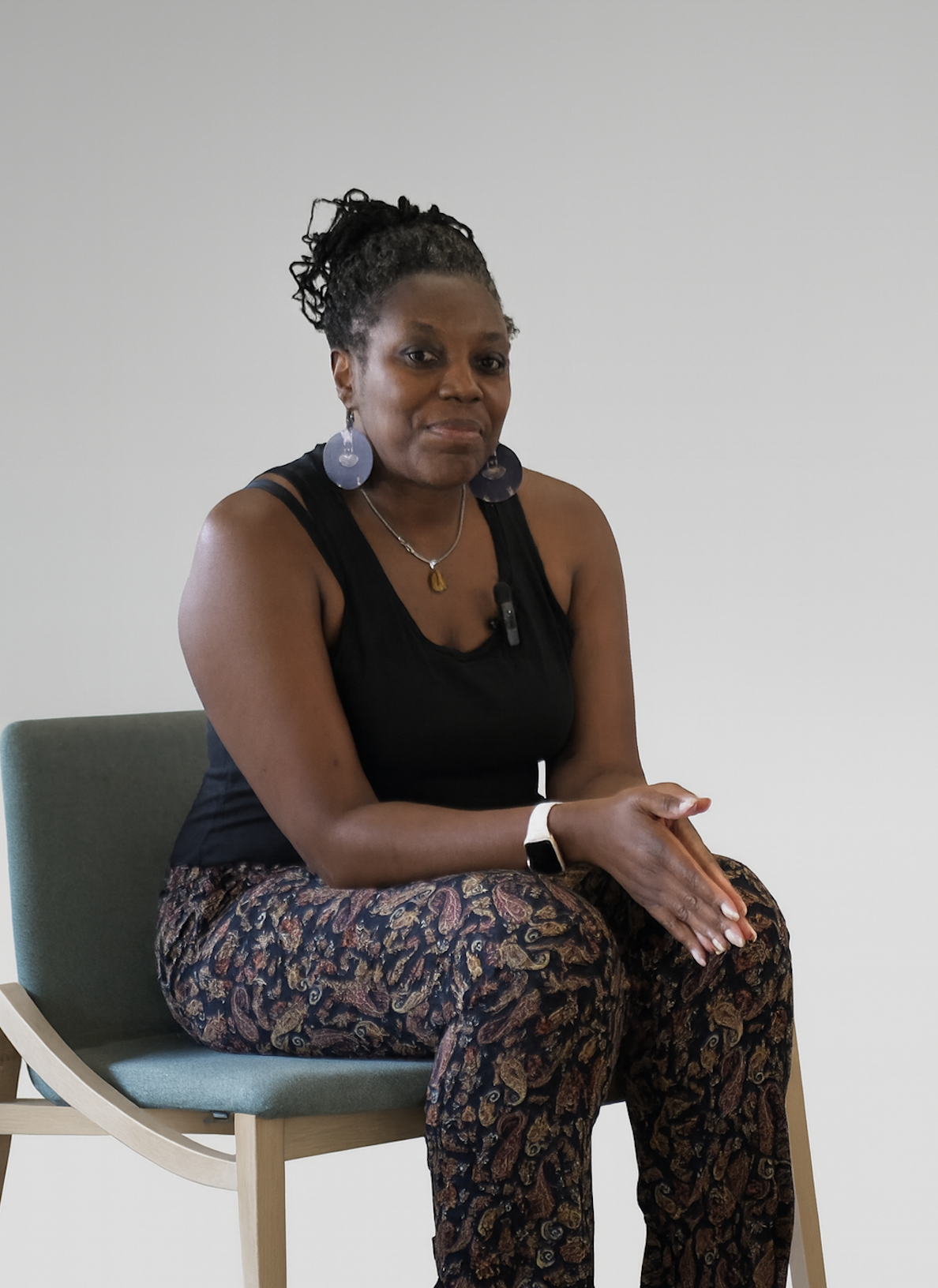
In this conversation, Zara Rahman reflects on time as a political and democratic resource, on care as a form of social infrastructure, and on the futures we allow ourselves to imagine through technology. Moving between mothering, digital policy, feminist technology and resistance to data centres, she questions the assumption that efficiency, scale and automation necessarily improve our lives. Instead, she invites us to think about technology in relation to care, autonomy and collective power: not as something we simply adapt to, but as something societies should actively shape around the futures they want.
Platoniq: Let’s start with time. If time is a prerequisite for staying informed, deliberating, organising or participating, should we start thinking about access to time as a democratic infrastructure, in the same way we think about access to education, information or public space?
Zara Rahman: Yes, definitely. I think we need to think about time in a more shared way: as a resource, as a gift, rather than as a privilege. Right now, we take time for granted, and the way we think about it is shaped so strongly by capitalist structures that we barely even question it. People say, “time is money”: I think that’s absolutely something we should question. Time is a necessity for participation in democratic processes, but also simply for having a good life, for not being exhausted. It’s a prerequisite for a healthy society.
Platoniq: In one of your recent blog posts, you highlight the distinction between Chronos and Kairos, two very different ways of understanding time. What do we lose when we organise collective life only according to Chronos: measurable, productive time?
Zara Rahman: We lose so much. To me, it almost feels like a way of giving in to capitalism. It’s like saying: yes, capitalism is the organising force around everything. I think we lose so much of who we are, or who we could be, as a society.
My latest book is about time, and the main thingI look at is mothering. There’s an assumption in many parts of the world that hat choosing to have a child means accepting that you will be exhausted for at least ten years. That’s absurd when you think about how society continues – whether we choose to have children or not, we all need children as part of society.
When we accept that everything has to operate through measurable units (ie. Chronos), we lose the ability to dream bigger
When we accept that everything has to operate through measurable units (ie. Chronos), we lose the ability to dream bigger and think beyond a quantitatively measured life. And I think that’s part of how we’ve ended up in the polycrisis we have today.
Platoniq: When you say “dream bigger”, what kinds of activities, ways of living or meaningful things are you imagining?
Zara Rahman: For the book, I thought a lot about different structures of caregiving and mothering that go beyond privatising responsibility for children. There’s amazing work around nuclear family abolition by Sophie Lewis, for example. For me, thinking bigger means asking what structures we actually need instead of assuming that the needs of a child should be the sole responsibility of one or two legal guardians.
Platoniq: Is there one particularly clear example that illustrates this?
Zara Rahman: Bogotá, in Colombia, has what they call Care Blocks. In low-income neighbourhoods, they have created spaces that bring together laundry services, childcare, learning and training opportunities, health and sports, all in one place within walking distance. The goal is to redistribute the responsibility of caretaking more equitably – so primary caregivers, the majority of which are women, get some time back to do what they want with. Children get the chance to spend time with each other. Laundry is taken care of. People can learn new skills. They explicitly think about this in terms of giving caregivers hours back to themselves, and they are seeing that when you give caregivers the gift of time, there are positive outcomes for everyone.
When we think of a mother, people often think of the person who gives birth or one of the primary parents. But mothering can be a verb. It can be the act of taking care of someone else. You can be an auntie and do mothering. You can be an uncle and do mothering. You can be anyone and see it as part of your responsibility to care for other people.
Especially in Western Europe, I think we have lost some of that language and those expectations of each other. In many other places, there is much more of an attitude of: there is a child here, so of course we will all take care of the child – as James Baldwin said, “the children are always ours, every single one of them”.
Platoniq: I’m very interested in this idea of mothering because it seems to contain very different experiences of time: presence, care, waiting, simply observing, emotional and physical attention. It’s very different from the time we associate with work. Why do you think this more intimate kind of time is so poorly recognised by the modern, capitalist world? Why isn’t it recognised as valuable time?
Zara Rahman: Because it isn’t measurable, I think. Under capitalist ways of thinking, time is money. An hour is an hour, and an hour is a unit of labour. It doesn’t matter whether you are genuinely present or what kind of attention you are giving during that hour. People are seen in terms of the labour they can deliver rather than the attention they can give, or the skills they can teach.
Mothering, or simply being with a child, especially a younger one, is such a lesson in how differently time moves depending on the situation
Mothering, or simply being with a child, especially a younger one, is such a lesson in how differently time moves depending on the situation. I’ve written about how, during birth, time is just wild. It’s this next-level rupture of everything you know. Before and after are almost all that matters.
That’s also something we don’t talk about enough with mothering. It’s presented as: “This is exhausting, this must be so tiring.” But you also develop an immense number of skills: emotional intelligence, empathy, time management, motivation. In professionalised civil society or social justice spaces, caregiving can sometimes feel completely disconnected from the work. But if we’re talking about shaping our futures and building our futures, child-rearing is one of the most concrete and impactful contributions we can possibly make.
Platoniq: I want to make a link that might sound strange at first: mothering and technology. How can we connect these ideas about time and care with the way we design technology today? They seem like two very separate things.
Zara Rahman: I don’t think about them as separate at all. Maybe that’s partly because my first book was about technology and my second is about mothering. One of the most concrete connections for me is how much parenting today involves negotiation and judgement about technology.
parenting today involves negotiation and judgement about technology
Platoniq: Do you think technology today is actually designed to give us more time, more autonomy, or more ability to decide how we want to live?
Zara Rahman: No. If we think about the big technology platforms, or even the underlying business model of most tech products, they’re built on capitalism and surveillance capitalism. They want more of your hours on their products because that makes the company more money. So it’s almost the exact opposite of what technology could have been.
Is it built to give us more time? No. It’s built to suck up as much of our time as possible. There are, happily, some nice alternatives being built. But by and large, there’s this appearance of efficiency: “This will save you time. This will make things easier.”
But what do we actually choose to do with that saved time? And what do we mean by “easier”? Apple Pay makes it easier for me to buy something because I don’t have to type in my credit card number. Great. But all that does is make it easier for me to buy more things. It’s not that I save time there and then think, “You know what? I’m going to volunteer. I’m going to use this time for something meaningful.” We don’t really have mechanisms that direct the time we supposedly save towards something else.
Platoniq: Exactly. We’re supposedly gaining time, but we don’t know what for.
Zara Rahman: Exactly. Things are made more efficient so that we can do more of them, not necessarily so that we feel better or have more meaningful interactions. I’m actually a big believer in friction in our tech platforms – intentional moments that make us think, do I really want to do this, or that give us a pause to reflect on what we’re doing.
Of course there are many situations outside of tech where people absolutely do not need more friction. If your life is already full of obstacles, then yes, anything that makes things easier can be helpful. But technology creates these interesting contradictions. Think about photography. Thanks to smartphones, we can take photos all the time now. It’s incredibly easy. And then we end up with 20,000 photos on our phones that we somehow have to filter through. Then we need to spend more time making a photo book, sorting them or deciding what to do with them – or we just ignore them entirely
Did that actually save us time compared with taking analogue photos and printing them? I don’t know. It’s a little absurd.
Platoniq: You’re now working at SUPERRR Lab on political imagination and feminist digital futures. What does a “feminist digital future” mean to you, particularly in contrast with the kind of digital future we’re living through now?
Zara Rahman: For me, the feminist part is mostly about being critical of power structures. It means taking an intersectional feminist approach and thinking about how people who sit at the intersection of historically marginalised identities are affected by what we’re doing. So feminist digital futures are futures in which we are all thriving.
A lot of our collective imagination around technology has been captured by Silicon Valley. They’ve been very good at telling compelling stories and constructing narratives that make their vision seem like the only possible way forward. That’s happened through a lot of intention and planning – including years of collaboration with Hollywood, a huge infrastructure of popular culture, technology building, resources and wealth flowing into this vision.
And again, it goes back to what I was saying about traditional family structures: it does not have to be like this. There is nothing natural about this. Even if we think about how AI is being built, there is nothing inevitable about the current direction: bigger data centres, bigger datasets, more data equals better. That is one possible route among a thousand possible routes.
feminist digital futures mean thinking about the roles we actually want technology to play in our futures
For me, feminist digital futures mean thinking about the roles we actually want technology to play in our futures: technology in service of us, in service of people, in service of hope and justice. Not the other way around, where we say, “Well, technology is like this. We don’t really like it, but we have to work around it.”
A lot of digital rights work can feel like harm mitigation. We’re constantly putting out fires: “This is terrible, how can we make it slightly less bad?” What we’re trying to do at SUPERRR is ask: How do we make it actively good? Instead of accepting somebody else’s vision and dedicating all our attention to making their vision less harmful, we need to ask who should be involved in imagining the futures we actually want. Otherwise, you’re giving up a huge amount of narrative power. We want our vision to be great, and then we want to work towards that.
Platoniq: So where do we start? What would be a first step towards changing the technological imaginary we have today?
Zara Rahman: At the policy level, one framing we’ve been working with is simply accepting that digital policy is social policy. Today there’s no such thing as saying, “This is just technology policy, so only this particular department needs to think about it.” Every tech and digital policy affects society. It needs to be analysed from that perspective.
And from an intersectional feminist approach, that means specifically asking how a particular policy proposal affects people who are disenfranchised, historically marginalised or ignored.
Platoniq: I have to ask about the elephant in the room: AI. In Machine Readable Me, you explore how systems of classification interpret and reduce us. With the expansion of AI, are you concerned that these forms of classification will become even more invisible and harder to challenge? And what kind of power should we have, individually or collectively, to challenge or redefine how these systems interpret us?
Zara Rahman: Machine Readable Me looks a lot at how digital classification reduces us to very surface-level boxes and categories that don’t accurately or fully represent our human selves. And I think that, like many technical systems, when AI draws on digital data it makes those categories and classifications more concrete.
I don’t think that problem is necessarily specific to AI. The same thing has happened with biometric technologies, for example. There have been waves of different technologies that rely on digital data. Another example is automated decision-making: governments using machine-learning systems to decide who receives social welfare payments. That’s a very similar problem. It wasn’t good then, and it’s still not good with AI.
But something happening now actually gives me a lot of hope. The resources required to make Silicon Valley’s vision of ever-expanding AI possible include ever-expanding data centres that consume huge amounts of resources. And the resistance we’re seeing to that is incredibly encouraging.
Unlike many issues in digital rights or technology policy, data centres create a very visible problem. They can occupy enormous amounts of physical space and consume huge amounts of electricity and water. Communities understand that these are finite resources. If you allocate huge amounts of water or electricity to cooling data centres, that might mean a city government doesn’t have enough resources for a new school that the community actually wants.
It gives me hope to see how these issues have come together and how widespread the resistance is, involving a huge range of groups. Before this, many of those people might not have felt that they had much agency or interest in technology policy. They might not have felt that technology policy decisions affected them. But here it’s very clear: yes, they absolutely do.
In my hopes and dreams, this becomes a gateway to the idea that SUPERRR has been working on for years that I mentioned before: digital policy is social policy. It’s an example of many people coming together and saying: “No. You’re making what looks like a digital policy decision, but it affects us. We don’t want this. We want this instead.” And perhaps that becomes an entry point for many more people to have a say in how technology features in our societies.

Platoniq: As with the example of mothering and the Care Blocks, can you give us one inspiring example from the technology field? Something that makes you think: this is one direction we could take.
Zara Rahman: Yes. There’s an amazing organisation called the Numun Fund, which is an intermediary fund supporting the growth of the feminist technology movement. A few years ago, this was basically a dream: could there really be multiple people working on feminist technology visions, projects and ideas and actually receive the resources to develop them? Now Numun Fund is a thriving intermediary fund.
I’ve had the absolute pleasure of being part of the selection committee. It uses participatory grantmaking, and reading the applications every year has been incredible. They mainly support people in the global majority, marginalised communities and different parts of the world.
The ideas, the motivation, and especially the ways in which people refuse to surrender their imagination, their narrative power or simply their power to Big Tech have been incredible. You can look through the grantees from previous rounds on their website. They’re wonderful projects and groups of people, and there are more and more people working in this way.
Platoniq: Thank you very much, Zara. It’s been a real pleasure talking with you.
Zara Rahman: Thank you for having me!
__
📸 © Briony Ridley