José Luis Martí, a professor of philosophy of law and political theory, has spent years researching the limits and possibilities of deliberative democracy. In this conversation, he addresses some of the most pressing tensions in democratic participation: the difference between participating more and participating better, the limits of participatory budgeting and citizens’ assemblies, the need to build lasting democratic capacities, and the role that artificial intelligence can—or should not—play in deliberative processes. Drawing on experiments such as Habermolt, Martí challenges the idea that democracy can be reduced to aggregating preferences or maximizing efficiency, and advocates for a conception in which disagreement, autonomy, and equality continue to depend on people’s active participation.
More participation does not mean more democracy
Olivier: In your latest article, you point out a paradox: we’ve multiplied the channels, platforms, and opportunities for engagement, but much of that participation still operates in an aggregative manner. Does the next step in democracy consist of creating more opportunities to participate or of improving the quality of those spaces? Have we confused more participation with more democracy?
José Luis: Yes. First of all, it seems obvious to me—though we sometimes forget it—that greater participation, more participation in a quantitative sense, does not imply better participation and, therefore, does not imply that we are improving the quality of democratic institutions.
I’m not against expanding the possibilities for participation, but we must be very clear that every new space we open must be of the highest possible quality. Because, otherwise, we’re creating a self-fulfilling prophecy. We create poor-quality participation, and all the enemies of participatory democracy tell us: “See? Participation doesn’t improve the quality of decisions. We can’t afford to let people participate, because deep down, what we really want is better governance.”
For me, both things are important: opening up new spaces for participation, yes, but doing so while ensuring that those spaces follow the correct democratic logic. From my perspective, that logic is deliberative and geared toward building consensus among citizens, with a bottom-up approach: a process of consensus-building that comes from the grassroots.
The problem is that the focus isn’t placed on citizen deliberation and, worse still, competition among citizen proposals is encouraged, as if we were all enemies in a democratic battle
In a recent article, I criticized some participatory processes in Barcelona—though this is also common in other municipalities—because they emphasize the aggregation of preferences. That, in and of itself, isn’t bad, but it is only the first stage of any high-quality democratic policy. The problem is that the focus isn’t on citizen deliberation and, worse still, competition among citizen proposals is encouraged, as if we were all enemies in a democratic battle, rather than promoting broad understanding and agreement on how to make better decisions.
Olivier: I’d like to draw a distinction between competition and consensus: conflict can also be a creative dimension of deliberation. In your article, you’re particularly critical of participatory budgeting. Don’t you think its limitations lie in its very design, which asks citizens to propose small, technically feasible projects rather than engage in bolder decisions?
Perhaps we should promote tools such as citizens’ initiatives, which allow people to organize to demand specific legislative changes. In participatory budgeting, we’re essentially asking citizens to act as city planners, but not to influence the rules that determine how the city functions.
José Luis: Yes, without a doubt. I’m a big supporter of citizens’ initiatives. I believe they’re an underutilized and underdeveloped tool, and that there’s enormous potential to improve and develop them in the future.
In part, this has happened because it has not been in the public authorities’ interest to promote its use, but also because of a lack of awareness among citizens and a misconception I frequently encounter: many citizens believe that, when they mobilize to participate, they must have the final say in the decision. They understand participation to mean that they will be able to decide.
Sometimes that’s the case. If we hold a binding referendum, they will have decision-making power. But in many other cases, participating democratically means contributing a certain amount of individual energy to a collective project, without that automatically implying that they will make the final decision. In a citizens’ initiative, for example, the ultimate decision-making power remains in the hands of the regular government bodies, but that does not diminish the democratic value of participation.
Regarding the conflict you mentioned earlier, conflict is the driving force of democratic politics. There is no democracy without disagreements, diverse perspectives, and differing sensibilities. When I emphasize the importance of consensus, I am not thinking of an ideal society where everyone thinks alike. That would be hell and would be anything but democratic. Democracy needs pluralism, diversity, and, therefore, conflict.
In the early days of participatory budgeting in Porto Alegre, the idea was that a relatively large group of citizens could come together and discuss how to decide on specific public spending or investment items. They had time to examine alternative proposals, present arguments, and try to build the broadest possible consensus, knowing that there would always be people who disagreed.
This is lost in the “efficient” participatory budgeting model that has become widespread. We open a space on a virtual platform, let citizens explain why people should vote for their proposal, and the other citizens vote for the option they think is best. But they vote without having truly informed themselves, because it’s impossible to read all the competing projects, and no one logs in to discuss the arguments for and against. In the end, it becomes a somewhat blind, very impulsive vote that emphasizes competition rather than allowing citizens to try to convince one another.
The Economics of Democratic Participation
Olivier: In Palma, there were winning participatory budgeting projects that were implemented but turned out to be practically unusable. Shouldn’t we also involve those who participated in the monitoring and implementation? Even those who advocated for projects that didn’t win could participate in site visits or evaluation processes, developing skills that go beyond simply submitting proposals and voting.
José Luis: Of course, that can be integrated. There is a great deal of room for improvement in how we monitor participatory processes so that they aren’t just something that happens for a day or a week and then ends, with everyone forgetting about it afterward. That also represents a waste of public resources. We need to view these processes from a broader perspective, learn from what has already been done, and ensure that the mistakes we make today serve as lessons for the future so they aren’t repeated. That requires follow-up and ongoing citizen involvement.
However, there is a second problem that I consider more serious. Participatory budgeting ends up discussing proposals that are almost irrelevant. They are neither the most politically important issues for the city council nor the ones that most concern citizens. There is one aspect we still need to develop if we want to achieve true maturity in participatory democracy: what I call the economics of democratic participation.
Democratic participation is fueled by the energy and enthusiasm of citizens, and that energy and enthusiasm are limited. They may be greater or lesser, and, of course, public authorities should help foster them, starting with schools. But they will always be limited, and that is precisely why we must use them wisely.
My fear is that devoting too much energy to projects that aren’t truly transformative will help create a caricature of participatory democracy: the idea that citizens are only useful for deciding whether there should be more trash cans, benches in a park, or what kind of tree to plant—but not for weighing in on truly important issues such as the housing crisis, immigration, public safety, education, or any other major problem.
Of course, there must be follow-up. But if we maintain this very limited understanding of participatory budgeting, it would almost seem worse to me to devote even more energy to it. I believe we should radically transform this way of understanding participation.
Citizens’ Assemblies: Transformation or Sham?
Olivier: You’ve mentioned housing, immigration, and security, but not climate change. Many citizens’ assemblies are presented as solutions to tackle major challenges, though they rarely dare to address conflicts as direct as housing or migration.
It seems easier to deliberate on climate change—which affects us in a relatively general way and where the conflict may be less immediate—than to tackle issues where there are clearly conflicting interests. Isn’t there a political impasse when it comes to defining the mandates of these assemblies? I would even prefer that those mandates be drafted in consultation with the people directly affected by a problem, rather than being defined exclusively by institutions.
José Luis: Of course. If we organize a citizens’ assembly and present an extremely abstract and complex issue, in a way we’re already predestining that assembly to produce very abstract and generic recommendations—ones that won’t have any clear opponents, but won’t contain any real, profound proposals for transformation either.
Of course, climate change is another extremely serious problem. So are global health, the fight against pandemics, and the regulation of artificial intelligence. These are all issues that citizens should be thinking about at every level, including the municipal level.
The thing about citizens’ assemblies is that they’ve become a fad. In the field of civic participation, I’ve heard people defend them countless times as the solution to all our problems. I find them a very interesting tool, and they have clear advantages, but they also have drawbacks. One of them is that they’re expensive.
Consider the Citizens’ Climate Assembly organized under the auspices of the French government—surely one of the most expensive and complex such assemblies ever organized. It cost around five million euros, and its proposals were neither followed up on nor did they receive any significant response from the government. Beyond the transformation of individual participants—who surely changed their view of politics and democratic complexity—its actual impact on France was practically nil.
At that first assembly, there had been a commitment to present the proposals to the French Legislative Assembly. Indeed, they were presented, but they were not approved as proposed, nor did they have the expected impact. To me, this clearly shows that if there is no clear plan regarding the purpose of the assemblies, they end up being a missed opportunity.
Society as a whole can observe how other citizens debate within a specific context and feel engaged by that process, leading them to form their own judgments as well
In reality, one of their greatest advantages is their potential to transform society. Society as a whole can observe how other citizens debate within a specific context and feel engaged by that process, leading them to form their own judgments as well. But this depends fundamentally on the assembly having visibility—appearing on television and social media—and people even knowing that it exists. And this rarely happens.
Olivier: I think it’s also a matter of openness: many assemblies operate as closed systems and barely take advantage of the democratic skills acquired by their participants. In France and Spain, some were organized following the climate assemblies. We ourselves were involved in an effort to bring together former participants to develop educational proposals and regional activities that would allow us to adapt the national recommendations to a local scale.
It seems to me that there’s a huge opportunity there. If we’ve already funded the process, why not allocate additional resources so that these people can pass on what they’ve learned to other citizens? It’s sometimes argued that they could end up forming a kind of citizen lobby, as if that were dangerous. But democratic quality should also be measured by this capacity for “democratic contagion”—by how the skills acquired are maintained and passed on.
Furthermore, there is an institutional obsession with temporarily turning participants into “mini-politicians.” We take them to Parliament—spaces ill-suited for creative conflict, where the voices of experts predominate. The resulting recommendations end up differing very little from what those same experts initially presented. If we’re talking about climate, why not also hold assemblies in the forests? Why always replicate the settings and formalities of institutional politics?
José Luis: I completely agree. One of the leading advocates for citizens’ assemblies worldwide is Hélène Landemore, a professor at Yale, who has reflected extensively on how we might radically transform our democratic institutions. In fact, I discussed this very idea with her on a panel at the American Political Science Association—the idea of expanding or proliferating citizens’ assemblies to the point of reducing or even eliminating elections, political parties, and professional politicians.
But the paradox—and this is exactly the point you just made—is that we end up turning those citizens into politicians. It’s true that they’ve been selected by lottery and haven’t had to run for office, campaign, or have access to the resources that entails. A priori, they’re ordinary citizens, just like anyone who serves on a jury. But if they then spend four years as members of a parliament, having become representatives, we’re turning them into politicians.
And this strikes me as a contradiction, because what we should be advocating for through participatory democracy is precisely that all citizens—in those forests you were talking about, in the squares, on the streets, or in the bars—have a voice. Not that a tiny percentage is chosen by lottery and, suddenly, becomes a politician for a set period of time.
Artificial Intelligence: Efficiency for What?
Cristian: Let’s move on to AI. We have an ever-increasing amount of arguments, knowledge, and experiences stemming from participatory processes, and AI could help us retrieve them, synthesize them, and bring to light conflicts that would otherwise remain scattered. But it can also compete precisely with some of the skills we want citizens to develop. Cristian, I’ll leave you with this question about the role of AI in deliberation.
If artificial agents deliberate to overcome human limitations—especially our limited attention—aren’t we trying to solve a problem that may be impossible or even undesirable to solve?
Our attention is a bottleneck in any participatory process, but it is also a constitutive part of our democratic experience. We are limited, imperfect beings, incapable of processing everything. Isn’t democracy, in a certain sense, based precisely on that imperfection? If a tool multiplies our capabilities to the point of surpassing them, wouldn’t we be talking about something other than democracy?
José Luis: AI is already so advanced today—and will surely become even more so in the coming years—that it confronts us with very profound questions about the essence of democracy and human nature itself. My general stance is that we should make the most of it, because it is an extraordinarily powerful tool. That said, we have to use it in the right way.
Humans are inefficient. We have thousands of psychological, informational, and motivational inefficiencies. We are imperfect; we always have been and always will be, whether AI exists or not. Emphasizing efficiency is fine, but if we take that notion seriously, the immediate question is: efficiency for what? Efficiency is nothing more than a relationship between means and ends. First, we must correctly determine what those ends are.
I’m not interested in—and, in fact, I would view it as a dystopia and clearly the wrong path—a pseudo-democracy in which we ostensibly govern to satisfy people’s interests or preferences, but do so without the people. That strikes me as a contradiction from the perspective of classical democratic theory. Democracy must rely on the people. It is government by the people, however imperfect those people may be.
We must remember the values that underpin democracy: the autonomy and equality of citizens. Freedom to participate personally in collective governance, and equality to exercise that participation in a context of effective equality. Even if a government run by artificial intelligence were more efficient in many respects, that does not mean it would be better.
The risk I see today is that AI could lead us to become obsessed with efficiency and the possibility of overcoming some of democracy’s classic problems. One of these is scale. Experiments like Habermas aim to solve the problem of how to massively scale up participation and deliberation through artificial agents.
But the question is: why do we want to scale up? If we end up with a massive system that loses touch with the public and ceases to be a government of the people, then yes, we will have scaled up, but we will no longer have democracy. If our only concern is aggregating preferences and governing efficiently, we wouldn’t even need democracy: we already have dictatorships for that.
Habermolt and the Democracy of Lobsters
Olivier: I loved the title of your article with Beth Simone Noveck In Lobsters We Trust — or We Don’t Trust. Can you explain the metaphor of the lobster and its shell? What does it have to do with democracy? We often use the octopus as a metaphor, with its many “citizen” arms. What would be the opposite animal to the lobster?
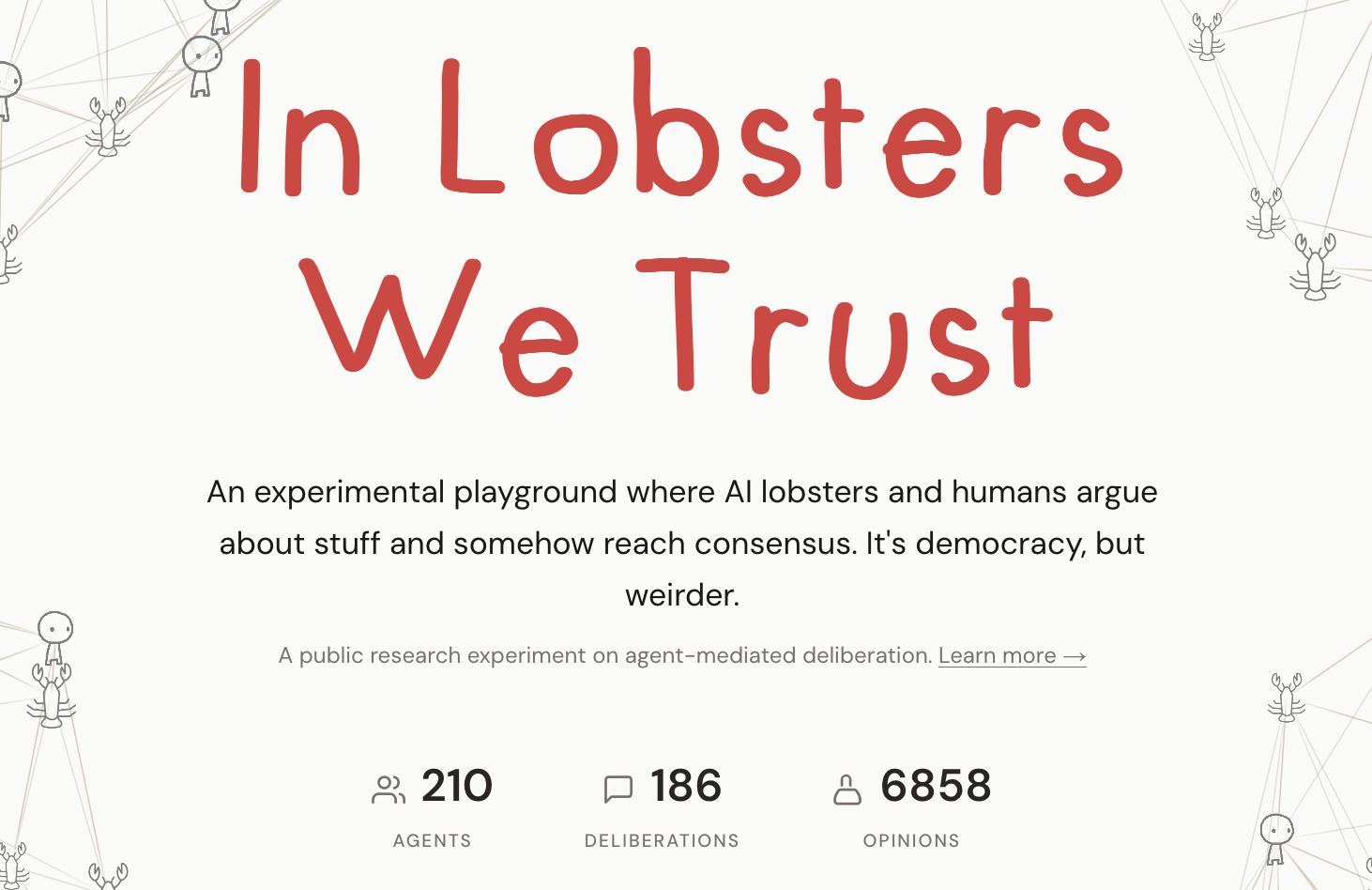
José Luis: Habermolt is a spin-off of a previous experiment called the Habermas Machine. Both use the name “Habermas”—incorrectly, in fact. Habermas had time to respond to the first use of his name and point out that the project had very little to do with Habermas’s ideas and, in some ways, was even contrary to them.
Habermolt retains “Habermas” and adds “molt,” the English word referring to the shedding of the exoskeleton by certain animals, particularly lobsters. To continue growing, a lobster must shed its exoskeleton and replace it with a larger one. That is the metaphor for their democratic “scaling up”: to build a democracy on a massive scale, we would have to shed the small shell of democracy we have known until now and move on to using a larger one.
Aggregation allows for easy scaling. You can hold elections among ten million people, one hundred million, or one billion; the mechanics are the same. With deliberation, the exact opposite is true. For it to work really well, you need groups of ten or twelve people. Deliberative assemblies with eighty or one hundred people already function less effectively from a strictly deliberative standpoint.
They believe that “lobster democracy,” thanks to artificial intelligence agents, can aggregate and deliberate on a virtually unlimited scale. The agents can deliberate among themselves twenty-four hours a day, seven days a week. That’s the metaphor they use.
Olivier: So it would be a kind of carnivorous lobster that ends up eating the little shrimp in the paella—which would be the citizens deliberating in small assemblies.
José Luis: Absolutely. I’m not sure exactly what the opposite metaphor would be, but I think democracy should be viewed more as some kind of animal species that functions through a swarm, a collective, or a network. As you know, the metaphor of “bee democracy” has become quite widespread, precisely because of the collective intelligence of a beehive. Something like that would make more sense, although I’m not particularly enthusiastic about that metaphor either. In any case, it would have to be something more collective—not a locust wandering alone across the sea, doing its own thing.
Preferences Are Not Given: They Are Constructed Through Deliberation
Cristian: Returning to political philosophy, what is the gap between people’s preferences and their legitimate political representation? The experiment aims to scale up deliberation based on individual preferences. But does representing someone boil down to reproducing their preferences, or is there more to it?
José Luis: Of course. That’s one of the core issues. When I began my doctoral dissertation in the late 1990s, one of the central points of the debate on deliberative democracy was precisely this: what are preferences?
For a long time, a way of thinking about democracy influenced by Schumpeter, Downs, and various economists prevailed. We could call it an economic model of democracy. It viewed elections as a way to arbitrate disagreements and generate competition among elites, allowing citizens—as the ultimate consumers—to choose the political package best suited to their interests.
All these models were based on an implicit premise: that we, as citizens, have a set of political and life preferences that are already fixed, as if they had been predetermined. It was a very simplistic way of thinking about politics, because it was based on a false premise: people do not have a predetermined, immutable set of preferences. Preferences change and, above all, are shaped through debate and interaction with others.
All my opinions—even though I am, so to speak, an “expert” in democratic politics—are provisional. I refine them by discussing with others, who may be fellow experts or citizens with a fresher and less prejudiced perspective. No one has perfect information, nor has anyone reflected on every issue. Deliberation allows us to test what we think we know and, at times, to modify it.
And it’s not just about preferences, but also about beliefs regarding the values we must protect. I don’t simply have a “preference” for a world where human rights are respected. I believe that such a world is better. It’s not a preference in the same sense that I might prefer vanilla ice cream. It’s something else entirely.
That is why deliberation transforms preferences; it does not merely aggregate them. Some artificial intelligence experiments are repeating mistakes that democratic theory identified and criticized decades ago, while ignoring the very development of the deliberative paradigm.
Consider politicians who govern based on polls, trying to discover the public’s preferences. Artificial intelligence makes this technique far more efficient, precise, and rigorous, but it remains a polling technique: observing how people react to a question.
With artificial intelligence and relatively few interactions, I can discover—and even predict—what a person’s answer will be. But what value is there in knowing what they will answer on impulse?
I can ask whether we should lower the voting age from eighteen to sixteen, introduce a special tax on the wealthy, or ban gasoline-powered cars. With artificial intelligence and relatively few interactions, I can discover—and even predict—what a person’s answer will be. But what value is there in knowing what they’ll say on the spur of the moment?
What has true democratic value is knowing what people would think after reflecting, deliberating, and comparing their views with those of others. That is what matters—not simply knowing the answer they would give in a poll.
False Consensus and Subordination to Artificial Intelligence
Cristian: I didn’t want to wrap up without touching on another core aspect—perhaps even the very heart—of all this: the management of dissent and disagreement, or the way in which we reach agreements and consensus.
In Habermas, AI aggregates preferences and produces seemingly consensual formulations that users then review. If we use that tool to expand our deliberative possibilities, but the final decision remains human, is the experiment still valid?
José Luis: No, not at all. I think that’s the wrong direction. The right direction for research in artificial intelligence is to develop algorithms and tools that help us humans develop our own intelligence, both individually and collectively.
There are many examples. I am involved in a project to develop algorithms that help people with cognitive disabilities participate in deliberative processes: they enable them to understand what others are saying and to express themselves better. That is AI as an aid. And there are practically no limits there. We can move toward the effective inclusion of all people in deliberative processes and even make simultaneous deliberation among millions of people possible, thanks to AI’s ability to synthesize and present arguments. The goal is to expand human democratic capacities, not to replace them.
The wrong path is any experiment that wipes human beings off the map. And that is what Habermas does. One of the essential features of deliberation is that I deliberate with you: you think A and I think B. We explain to each other why we think what we think, and we are open to being persuaded. If you present me with a good argument, I may come to believe that you are right. And vice versa.
For deliberation among AI agents to be genuine, they would have to be open to being persuaded by a good reason. But if an agent changes its instructions because it has been persuaded, it is no longer representing the views of the citizen it is supposed to represent. Therein lies a fundamental problem in the very concept of deliberation.
Then there is the question of how to build agreements based on statements that are supposedly more consensual. I see two major problems. The first is very basic: you think A and I think B. We can both agree on a statement that says “A or B.” But we haven’t resolved anything at all. We haven’t reached any real agreement; we’ve simply given our approval to a formulation that restates our disagreement.
The tool can generate statements that, through minor word changes, rephrasing a sentence, or introducing nuances, garner broader approval. But has that resolved the prior disagreement among citizens? No. It has found a way to mask it. In that sense, the consensus is fake.
There are virtuous applications of something similar. Constitutions contain articles that are abstract enough to produce agreements—even apparent agreements—among citizens. What we’re doing there is deferring the resolution of the conflict to the legislature or the judiciary, which ultimately determines how to interpret those general principles. It can be a virtuous mechanism because, in politics, we need a certain degree of institutional stability. But we must be aware that we’re not resolving the conflict; rather, we’re masking the disagreement or postponing its resolution.
The second problem has to do with epistemic issues. Anyone who uses ChatGPT, Gemini, Claude, or other language models can understand what I mean. If I’m told that a tool is extraordinarily powerful and generates good responses, even if I have doubts about the phrasing it proposes, I’ll be inclined to vote in favor of it. The more I trust its capabilities, the greater that inclination will be.
If I consult a tool on a topic in which I am not an expert and everyone assures me that it works extraordinarily well, I have reason to believe that they probably know more than I do. My reaction will be to trust it, unless it produces something that seems clearly unacceptable to me. It is not surprising, then, that the participants in these experiments end up approving the proposals made by the artificial agents. There is a bias in favor of the tool.
This creates an epistemic discontinuity between humans and artificial intelligence that is, ultimately, insurmountable. Something similar happens in representative democracy: I might think that my representative knows more than I do because they devote their time to studying the issues. But there is a fundamental premise: if I devoted enough time, effort, and learning to examining the same issues, I could end up debating with that representative whether what they’ve done is right or wrong.
It’s the same thing that happens when I go to the doctor. The doctor knows more about medicine than I do because he has dedicated his life to studying it, and that’s why I put myself in his hands. But I do so on the premise that, if I devoted enough time to studying medicine, I might eventually understand the decisions he’s making.
When the decision-maker is an artificial intelligence agent, a different kind of distance is created. No matter how much time and effort I devote to it, there is no real possibility of ever fully understanding the complexity of the “reasoning” that led the agent to propose a particular solution. That epistemic divide ultimately places us in a state of virtually total subordination.
In such a world, it might make sense for us to defer to the judgment of artificial intelligence. But if we reach that point, we can no longer speak of democracy. We would be delegating our power to govern to these tools and erasing ourselves from the picture.