Deep dives
La Escuela de Creatividad y Democracia: fortalecer las capacidades democráticas de las entidades socialesThe School of Creativity and Democracy: Strengthening the Democratic Capacities of Social Organizations

How can social organizations strengthen their democratic capacities, incorporate new forms of participation, and turn the experiences of the communities they work with into proposals for political transformation? The School of Creativity and Democracy (ECD), spearheaded by the Platoniq Foundation, offers an answer: learning to participate, facilitate, and advocate through practice.
In a context marked by political disengagement, polarization, and distrust of institutions, social organizations serve as essential spaces for gathering, collective organization, and the defense of rights. However, promoting participation is not merely a matter of calling meetings or conducting consultations. It requires learning to listen to diverse experiences, recognize inequalities, manage conflicts, build consensus, and translate social demands into proposals capable of driving change.
The ECD was founded as a laboratory for democratic experimentation that combines training programs, creative methodologies, and real-world experiences of participation. Its goal is to strengthen the capacities of those who drive democratic processes within social organizations, communities, citizen movements, and institutions.
From Training to Action: Learning Democratic Skills in Real-World Contexts
How do you facilitate a debate between opposing positions? How do you include voices that are typically excluded from decision-making spaces? How do you turn experiences of discrimination into policy proposals?
The School is based on a premise: democratic skills are not acquired solely by studying participation, but by practicing it. Its curriculum combines an intersectional approach with methodologies from the performing and visual arts, participatory research, and open civic technologies. Through practical exercises, rehearsals, and prototypes, participants explore Legislative Theater, participatory ethnofanzines, collective mapping, audiovisual translation, and digital platforms for deliberation.
For a social organization, this repertoire allows it to go beyond the usual consultation formats. Legislative Theater allows conflicts to be acted out and alternatives to be rehearsed; collective mapping helps identify barriers invisible in conventional assessments; artistic languages open up avenues of expression for those who cannot find their place in formal debates; and digital platforms offer continuity and scale to the conversation.
What sets the ECD apart is its commitment to making an impact while learning: connecting education with real participatory processes developed in collaboration with communities, organizations, and institutions. During the first edition, a teaching unit on democracy and creativity was rolled out in schools in Madrid and Barcelona; Mindset Revolution was launched in partnership with the University of Birmingham and the Kasal de Joves de Roquetes; and the program collaborated with the Spanish Civic Assembly to disseminate the 172 recommendations of the Citizens’ Assembly on Climate Change. Research was also conducted on the relationship between time and participation, the right to the city, and youth eco-social unrest.
The experience gave rise to a learning community with complementary skills: facilitating safe and inclusive dialogues, designing digital processes, conducting creative research, and connecting community conclusions with campaigns and institutional advocacy.
Five Real-World Experiences to Strengthen Democratic Capacities
The following five policy briefs, developed as part of the three-month training program for the first cohort, document both specific social issues and ways to learn how to address them through participation. Each experience highlights a capacity that can be applied to the day-to-day work of social organizations.
1. Time Is Also a Democratic Right
Democratic capacity: recognizing and transforming structural barriers to participation.
If time is unevenly distributed, so is democracy. An experiment in participatory democracy investigated the extent to which a lack of time excludes caregivers and those working long hours from decision-making spaces.
Between March and June 2024, 352 responses (323 valid) were collected in an exploratory survey on OpenSpaces (Decidim), supplemented by 12 interviews with experts in participation and gender and data from the European HETUS survey. Participants were asked about paid work, caregiving, commuting, participatory practices, and the barriers to them.
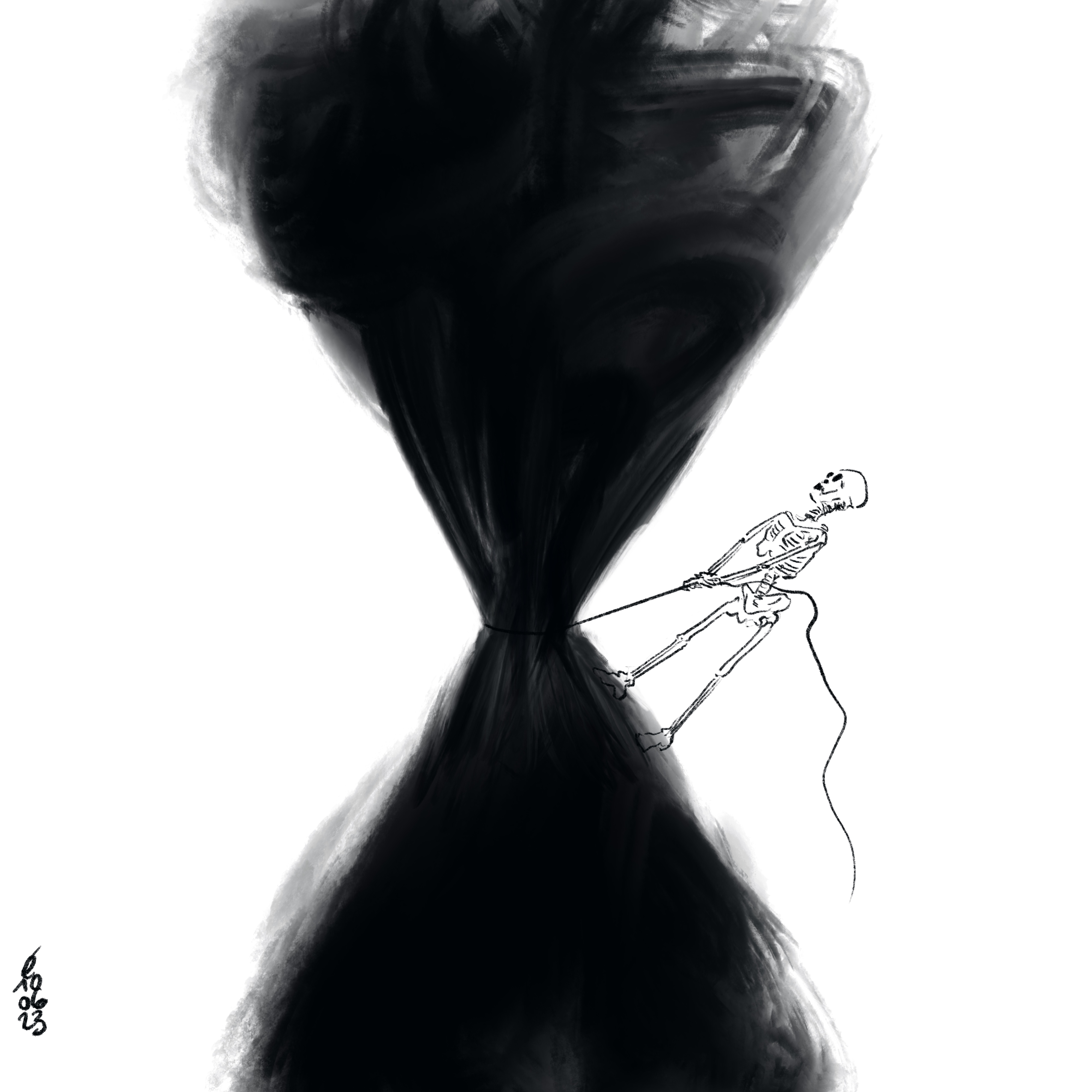
El tiempo aprieta
Esepe (2023)
The results showed that many people spent between three and six hours a day on unpaid care work, with a disproportionate burden falling on women. When combining work and care, women’s daily hours ranged from seven to seven and a half hours, compared to about six or six and a half hours for men. Community activities, volunteering, and politics accounted for barely seven to ten minutes a day. These barriers intersected with gender, social class, immigration status, and life stage.
What can social organizations learn? Simply issuing a call for participation does not guarantee participation. Adjusting schedules, introducing asynchronous formats, facilitating work-life balance, and reducing the material costs of participation are democratic decisions. Without temporal justice, participation can become a privilege.
- What schedules and formats exclude people with caregiving responsibilities?
- What time commitment does participating in our activities require?

2. Youth Mental Health: Learning to Listen Before Designing Solutions
Democratic Capacity: Facilitating Inclusive Processes and Translating the Experiences of Affected Groups into Policy Recommendations.
For three years, young people from Manchester and Barcelona worked with Platoniq on participatory research and creative democracy related to mental health. In Mindset Revolution, Foro Joven, and CoActuem per la Salut Mental, they used Legislative Theater, digital participation, in-person assemblies, and collective mapping to articulate experiences of inequality and translate them into recommendations for health services, educational institutions, and local governments.
The key factor was recognizing them as key decision-makers, not merely as people being consulted. They also evaluated their own participation and the impact they perceived, thereby strengthening their confidence and capacity for advocacy.

Presentation of the findings to the Catalan Youth Agency
Platoniq (2025)
Between June 23 and 26, 2025, young people from Barcelona traveled to Manchester to further explore the proposals, following a discussion on a collaborative podcast. They worked on four issues—eco-anxiety, gender equality in schools, tokenism, and housing insecurity—and discussed three proposals with public and social sector stakeholders from Greater Manchester.
- Proposal 1: Every school and workplace has an Equality and Rights Department
- Proposal 2: Creation of a Council on Responsibility and Legacy
- Proposal 3: Promotion of safe spaces to try out new ways of working
What Can Social Organizations Learn? Listening is a practice that requires an environment of trust, attention to power dynamics, and a real opportunity to influence the process. The methodologies used allow us to move from identifying needs to co-designing solutions, without reducing participation to a mere symbolic gesture.
- Who decides which issues are investigated and which recommendations are prioritized?
- How do we know if participants can truly influence the process?

3. The Right to the City: Transforming Experiences of Exclusion into Policy Proposals
Democratic Capacity: Using Creativity and Deliberation to Translate Everyday Conflicts into Collective Demands.
On July 10, 2025, fifteen young people aged 18 to 30 participated in a workshop in Barcelona on the right to the city, alongside young migrants supported by the Fundació Barcelonactua, rights activists, and a representative from the Generalitat. The session was facilitated by the ECD cohort itself, putting into practice what they had learned throughout their program.
An initial assessment identified friction points and forms of exclusion in everyday life. These experiences were transformed into scenes for the Legislative Theater, using scripts, gestures, objects, and improvised props to highlight the difficulties involved in navigating bureaucratic procedures and accessing rights.
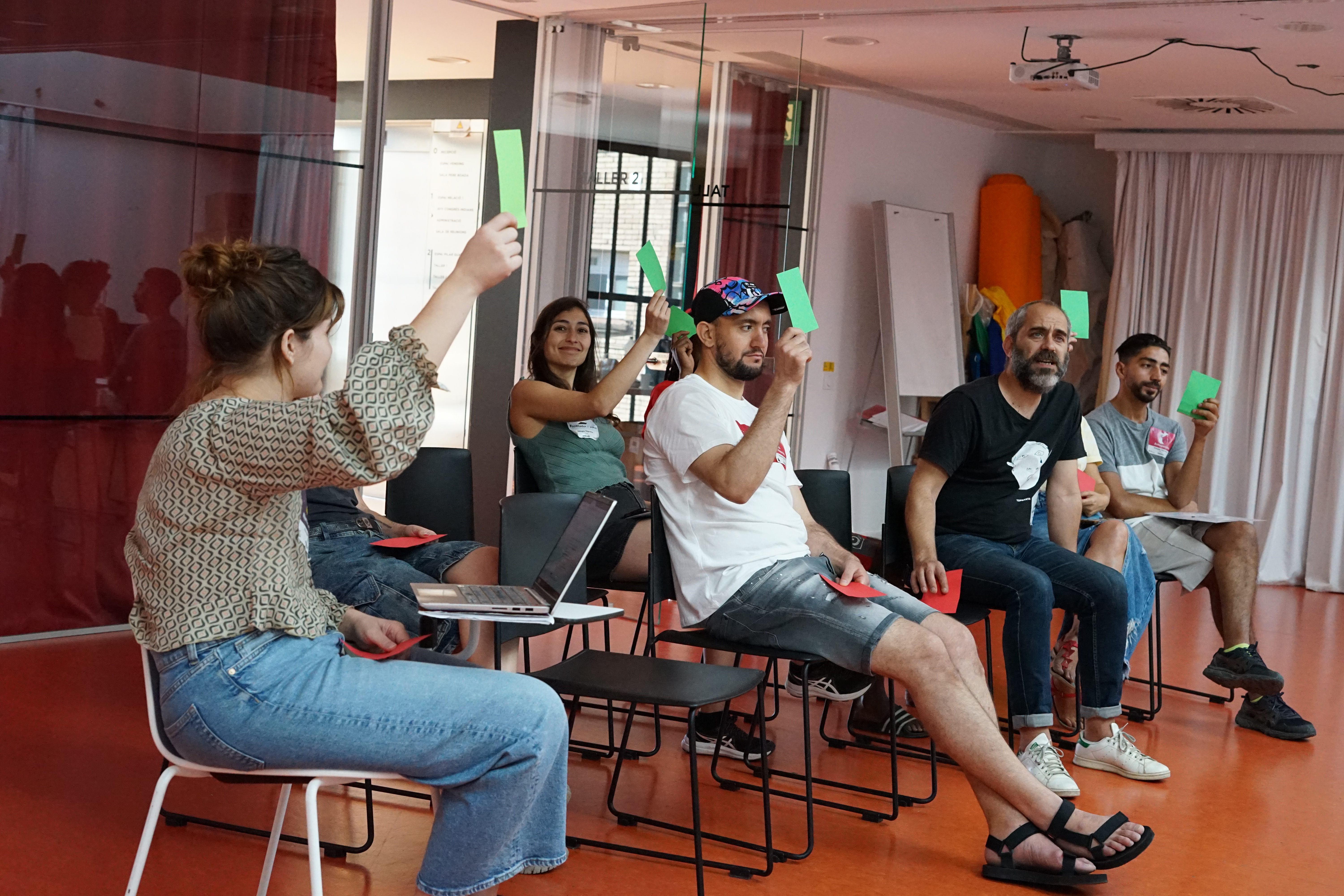
Voting on political proposals
Platoniq (2025)
Subsequently, the political laboratory led to the formulation of two proposals: just pathways to citizenship for vulnerable young migrants and digital administrative processes with human support. The measures addressed the fragmentation of educational and residential systems, bureaucratic complexity, and the lack of coordination between government offices.
What can social organizations learn? Portraying a situation of injustice allows us to explore its causes, listen to different perspectives, and test alternatives. The goal is not to speak on behalf of those experiencing inequality, but to support them so that their experiences can guide concrete proposals.
- Who defines the problems and who formulates the solutions in our projects?
- How can we turn everyday stories into proposals for institutions?

4. Migrant Mothers: From Recognizing Violence to the Collective Construction of Rights
Democratic Capacity: Creating Safe Spaces, Working Through an Intersectional Lens, and Building Solutions to Discrimination.
In Barcelona, in 2025, a group of migrant mothers transformed situations of discrimination into scenes of Legislative Theater: being denied access to housing for wearing a hijab, workplace prejudice against single mothers, and challenges to the right to healthcare. The audience participated as spect-actors to reshape the stories and rehearse collective responses.
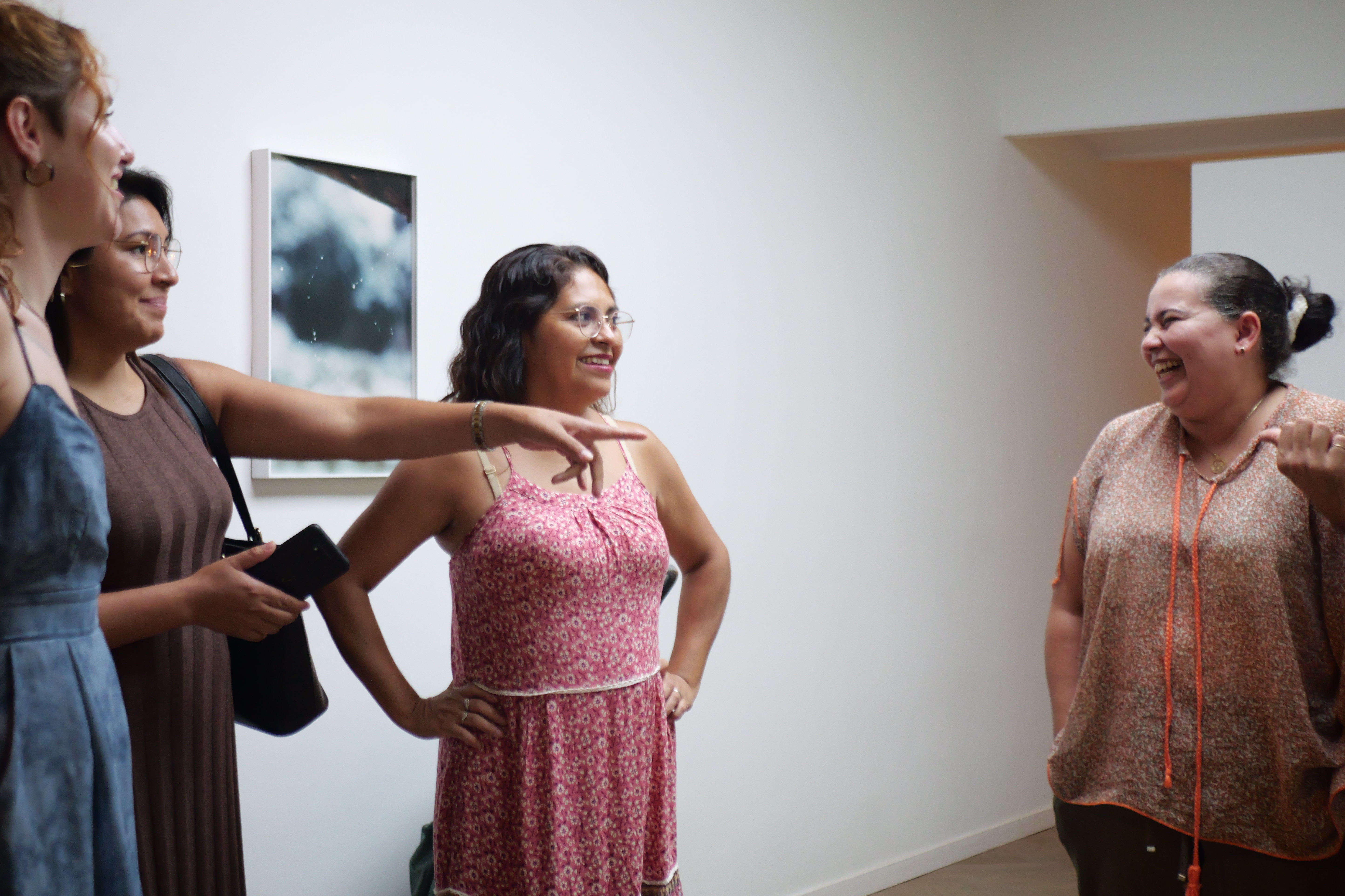
Participants after the Legislative Theater workshop
Platoniq (2025)
The process focused on three areas of transformation: decent housing, including for long-established families without proper documentation; fair employment, with protection against exploitation; and social and health services free of discrimination, through community mediation and intercultural training. These experiences revealed how gender, origin, motherhood, and immigration status intersect to create specific barriers.
What can social organizations learn? Adopting an intersectional perspective means understanding how structures of inequality combine and reviewing the conditions for participation. People typically defined as recipients of aid can take a leading role in creating solutions.
- What forms of discrimination intersect in the experiences of our community?
- What conditions would allow for participation without reproducing power dynamics?

5. Eco-anxiety and Youth Participation: Turning Discontent into Collective Action
Democratic Capacity: Using Creative Languages to Facilitate Expression, Deliberation, and Advocacy.
On July 11, 2025, a conference on eco-anxiety, mental health, and youth disengagement began with a roundtable podcast hosted by Alejandra Gallardo alongside Sara S. Ribés and Carla Riera. The discussion addressed the need for meaningful channels of advocacy so that concern about the climate crisis does not lead to a sense of powerlessness.
A fanzine workshop allowed young people to explore their emotions and ideas through collage, writing, and images. Afterward, a political lab organized by Platoniq synthesized the contributions into strategic lines of action.
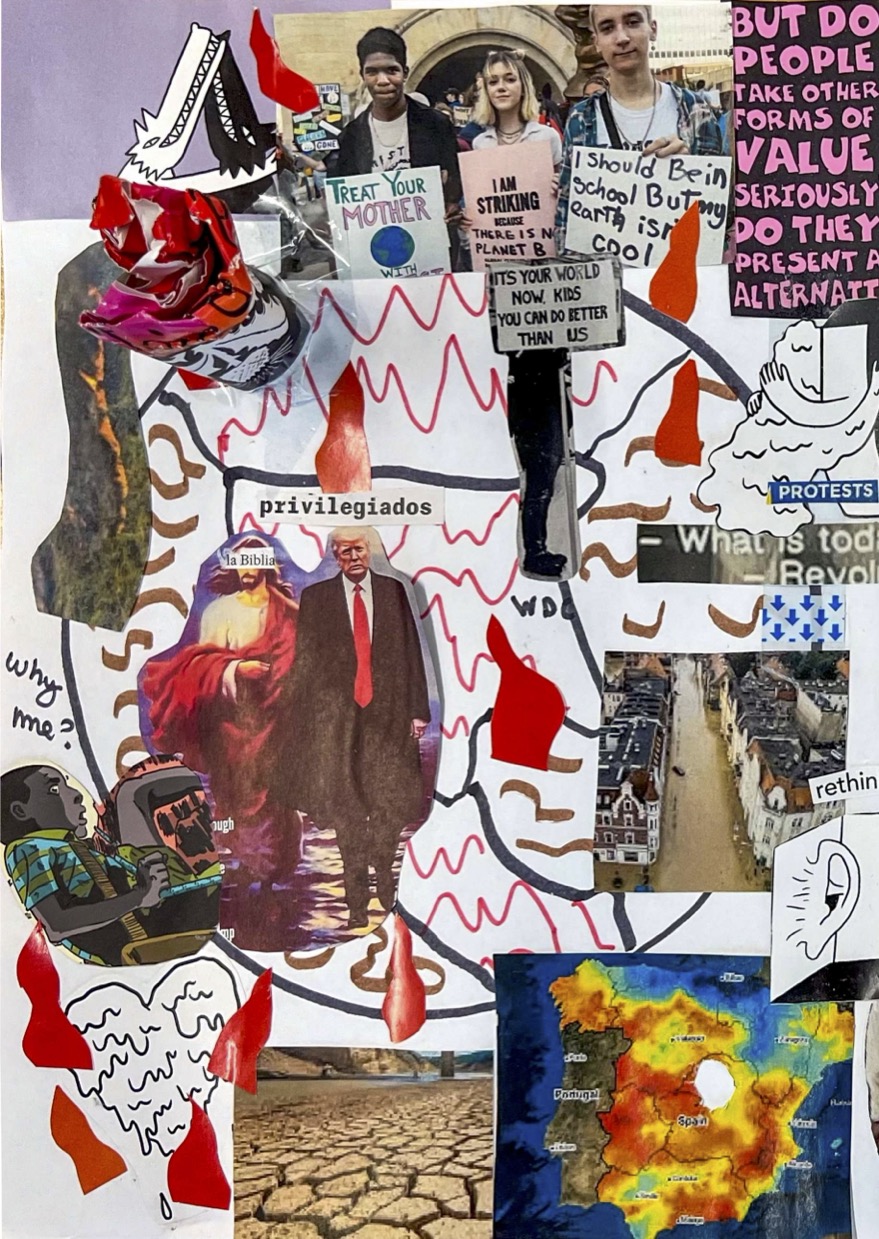
Resultado del taller de fanzines
Platoniq (2025)
This led to three proposals: incorporating eco-anxiety into mental health and climate action policies; making deliberation a stable part of the educational infrastructure in middle school, high school, and vocational training; and integrating emotions and creativity into deliberative spaces through theater, fanzines, and other methodologies.
What can social organizations learn? Conventional debates do not offer everyone the same opportunities for expression. Creative tools help recognize shared experiences and transform concerns into visions for the future and advocacy proposals.
- What forms of expression could help people who are rarely present at our meetings to speak up?
- How do we connect creative contributions with concrete decisions and commitments?

What democratic skills can social organizations develop?
These five experiences show that democracy is also a set of skills that can be learned and practiced. ECD offers opportunities for social organizations to develop skills in listening to and acknowledging diverse experiences; identify intersectional barriers; facilitate conflicts and difficult conversations; experiment with Legislative Theater, mapping, and digital media; turn assessments into collective recommendations; and connect those recommendations to institutions and decision-making processes.
This learning is useful both for improving internal organization and for driving community processes, supporting groups, and developing advocacy campaigns. What matters is not only the quality of a methodology, but who can participate, under what conditions, and to what extent they can influence the outcome.
A school for learning, experimenting, and transforming
The first edition demonstrates that democratic education can go beyond the mere transmission of knowledge: methodologies become tools for change when applied in real participatory processes. Policy briefs allow these lessons to be understood and adapted to diverse social contexts.
For social organizations, the School of Creativity and Democracy aims to strengthen the ability to listen, deliberate, create with others, and advocate publicly, while also examining how power is distributed within participatory processes themselves.
Democracy is also something that can be learned. And, above all, it is learned by practicing it.
A project made possible thanks to the support of Open Society Foundations.