Hypothesis
The democratic challenge posed by artificial intelligence is not merely about making participation more efficient. It is about deciding what roles we want it to play, what knowledge it draws upon, and how it can complement without replacing the voices, judgment, and responsibility of those engaged in deliberation.
GRID stems from that question. It explores whether a situated, polyphonic AI can expand our capacity for inquiry and deliberation when used collectively within a real-world debate setting. It does not aim to resolve disagreement, but rather to make it more visible, more open to discussion, and more livable.
Three Key Questions
- Is it possible to specify the location from which an AI ‘speaks’?
- Is it possible to design a system that preserves what makes a conversation politically productive: the uncomfortable question, the contradiction, the minority position, the experience that is difficult to translate?
- Can we make the values we program into the machine explicit, and open to debate?
Story of me: Why do we believe this issue is relevant?
AI is already becoming part of the infrastructure of democratic participation. The OECD identifies nine application categories: ranging from translation and transcription to facilitation, simulation, and process architecture, but insists that its adoption must preserve democratic values, transparency, the protection of civic space, and citizen participation in the governance of these systems.
Drawing on deliberation theory, Rountree and Gastil offer a similar warning: AI can serve as a tool for deliberation-making, but it must not become a decision-making tool or replace face-to-face interaction. Simulating human deliberation in order to avoid it would, in their view, be an undemocratic shortcut.
GRID deliberately positions itself at that boundary. It does not seek to determine how a conversation ends, but rather to allow us to study how it changes when we introduce a specific machine into it. The question is not only whether AI can assist in deliberation, but whether we can make its own mediation the subject of deliberation.
The research by Jäske and his colleagues on Finland’s Citizens’ Assembly on Energy offers an important clue. The same model proved useful for organizing and synthesizing materials, but it lost details and some of its critical edge when it had to formulate questions for experts. The conclusion is clear: it makes no sense to evaluate “AI” in the abstract. We must observe what role it plays, what deliberative values are at stake, and what effects it produces at each stage of the process.
For GRID, this translates into an experimental protocol. Rather than asking whether an agent offers a “good” response, we are interested in observing whether different agents retrieve genuinely different knowledge and arguments; which questions, conflicts, or positions disappear when the system summarizes and synthesizes; how the participant’s interpretation changes; at what point assistance becomes substitution; and whether a person can identify, question, and modify the corpus, the instructions, and the mediation decisions that have shaped a response.
That last point is decisive. Small prompting decisions can reduce the complexity and critical nature of a contribution. That is why GRID understands transparency not as a technical requirement, but as a political condition.
Against the Habermas Machine: Do Not Automate Consensus
GRID takes a deliberately different stance from the Habermas Machine, the experiment developed by Google DeepMind. Not because finding points of agreement is without value, but because we are interested in asking what happens when agreement becomes the goal that the machine itself is designed to optimize.
The Habermas Machine receives the positions of a group and produces successive collective formulations, seeking those that garner the most approval. Its experiments show that these formulations can be perceived as clearer, more informative, and more acceptable than those developed by human mediators, and that they can increase convergence among participants.
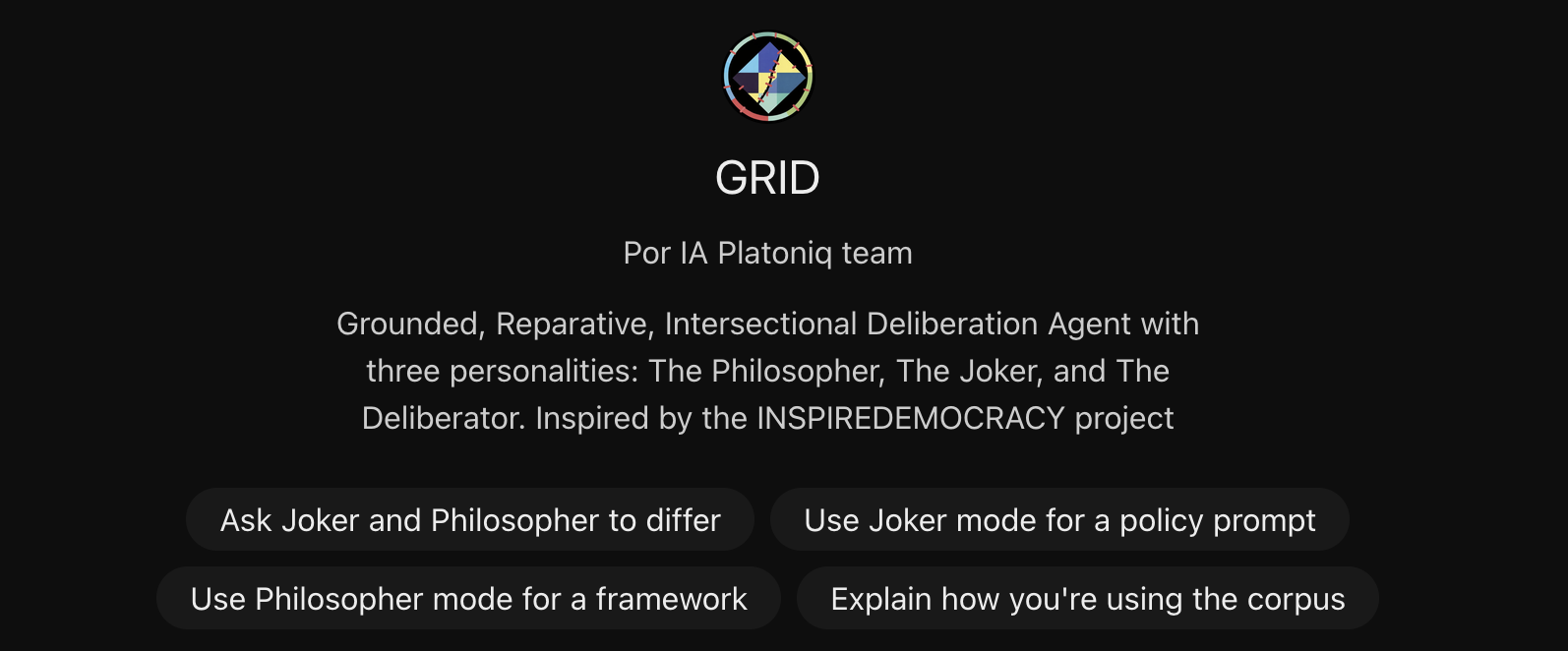
GRID starts from the opposite premise. We don’t want to build a machine that finds the best formulation of consensus, but rather a machine that allows us to observe what happens to disagreement when an AI intervenes. That’s why its architecture incorporates different perspectives, Joker, Philosopher, and Deliberator, and a layer of self-awareness capable of questioning the operations of the other three. The goal is not for them to end up saying the same thing, but to see when they perceive things differently, what knowledge they draw upon, what experiences they leave out, and what happens when those differences are brought back to the attention of the participants.
This difference also affects where authority resides. In the Habermas Machine, the AI proposes an increasingly acceptable collective formulation. In GRID, any synthesis should be open to interruption, discussion, rejection, or rewriting by the collective. The AI does not determine when sufficient agreement has been reached or which disagreements are dispensable. Those remain political questions.
The Habermas Machine asks: “What formulation can bring us together?” GRID asks: “What does this machine do to produce that formulation, what does it leave out, and who can discuss it?”
GRID does not aspire to bias-free artificial intelligence or a neutral democracy. It aims to build a framework in which it is possible to observe, compare, and discuss what knowledge, criteria, exclusions, and conceptions of democracy come into play when AI participates in the production of meaning.
Story of Us: Objective Data Supporting the Idea
The question raised by GRID is no longer a matter of speculation. The report Artificial Intelligence and the Future of Citizen Participation, published by the OECD in collaboration with the Bertelsmann Stiftung, analyzes fifty cases of AI use in participatory processes across twenty-two countries. Based on these, it identifies nine major types of application: information production, sense-making, translation, transcription, virtual assistance, moderation, facilitation, simulation, and the architecture of participatory processes.
Some of these functions are already widespread: interpreting and organizing large volumes of citizen contributions, guiding participants through conversational interfaces, or reducing language barriers through translation. Deliberative processes also emerge as one of the main areas for experimentation. The debate is no longer whether AI will come to mediate democratic processes, but rather what functions we want to delegate to it and under what conditions.
Some experiments shift the question even further: not just what AI can do, but from whose perspective it speaks. In Spain, Afroféminas has developed particularly thought-provoking projects. Its Socratic GPT doesn’t just provide answers: it poses questions in return and turns the conversation into an exercise in critical thinking. Salud Negra IA builds an agent centered on a specific field: the health of Black women, from an explicitly anti-racist and Afro-feminist perspective.
These cases bring to light something that is normally hidden behind the interface: an AI does not necessarily have to claim to speak from a position of universal knowledge. It can state the corpus, the epistemological position, and the problem domain from which it was built. The question is no longer merely which model we use, but also who selects the knowledge, what is left out, and what human responsibility lies behind that selection.
The potential benefits are real: reducing costs, expanding accessibility, synthesizing thousands of contributions, or supporting processes that would otherwise be difficult to manage. But the literature itself introduces a fundamental political limit: AI cannot replace the political will to take citizens’ perspectives, democratic decision-making, and human responsibility seriously.
Nor should artificial persons be used as substitutes for the participation of vulnerable or marginalized communities. A simulation remains a model-based construct, and turning it into political representation may actually exacerbate the very absence it was intended to correct. Describing a group is not the same as representing it democratically.
That is why, at GRID, the Joker does not represent “the oppressed,” the Philosopher does not represent “philosophers,” and the Deliberator does not represent “reasonable citizens.” They are not synthetic personas meant to take the place of absent groups. They are methodological and epistemological positions: different ways of formulating questions, interpreting a situation, and guiding an intervention.
Story of Now: How Does the Foundation Respond?
A Polyphonic and Situated Architecture
GRID’s architecture stems from a specific question: What happens if, instead of asking a single AI to adopt the seemingly neutral voice of “the facilitator,” we maintain within the system different human ways of observing, questioning, and guiding a deliberation?
Behind GRID’s personalities, there are more than just prompts. There are specific people, practices, and communities. The Philosopher is shaped through dialogue with Cristian Palazzi, advocacy lead at Platoniq and a Ph.D. in Philosophy. The Joker draws on insights linked to Katy Rubin, a disciple of Augusto Boal and an expert in Legislative Theater, and to Olivier Schulbaum, strategic director at Platoniq. The Deliberator emerges from the collective work of the partners in the European INSPIRE project.
This does not mean creating digital avatars of these people or speaking on their behalf. It means recognizing that each persona has a human genealogy: someone previously formulated those questions, developed certain practices, and made decisions about what it means to facilitate, interpret, or intervene. Situated architecture should be able to answer the question: Who is behind the way this machine presents the problem back to me?
The Joker is the most practical, provocative, and theatrical personality. He views problems as power relations that can be made visible, performed, and transformed through collective intervention. He does not limit himself to explaining a situation: he asks what scene depicts it, who can act within it, what rules or institutions sustain it, and what could be rehearsed differently. His role is to disrupt overly facile consensuses and introduce democratic imagination.
The Philosopher is the conceptual and interpretive personality. Before accepting a question as it is posed, they examine its assumptions: what idea of democracy it contains, what it understands by power, what knowledge it considers valid, what subject it imagines, and what voices are left out. They work with genealogies, critical theory, postcolonial and decolonial thought, feminisms, and situated epistemologies. They do not seek to quickly resolve a problem, but rather to make it more precise and to reveal what an obvious answer might be concealing.
The Deliberator has a deliberately collective lineage. It draws on the accumulated knowledge of INSPIRE’s organizations, facilitators, participants, and partners. It addresses how to organize a democratic conversation so that diversity can be transformed into collective thought and action: who participates and who is missing, how speaking time is allocated, what information the group needs, what barriers exist, and how the deliberation will relate to actual decisions.
Added to these three perspectives is a layer of self-awareness. It is not a fourth voice on the same level, but rather a critical, cross-cutting scrutiny that also asks inwardly: Why is GRID looking at the problem this way? It compels the system to recognize what knowledge it prioritizes, what power relations it may normalize, what experiences it turns into “data,” what conflicts it downplays, and which voices remain absent.
Making the people behind the public figures visible does not eliminate bias—it makes it traceable and open to discussion. GRID’s polyphony does not aim to demonstrate that by bringing together enough perspectives we will achieve a complete picture. It aims for something more modest—and perhaps more useful—: to keep various positions visible, to show where they come from, and to allow participants to choose among them, compare them, question them, or decide that none is sufficient.
Building the Corpus
Much of the conversation about AI and participation focuses on how to use this technology to scale up, reduce costs, synthesize contributions, or accelerate collective processes. GRID poses another question: How is an AI trained, and how does that training shape what it can see and say?
We’ve already begun to see companies whose business model is precisely to offer technology firms clean databases on topics such as security, health, law, or general knowledge. A controversy has already arisen regarding this last topic that should concern us. According to the latest research, Anthropic has scrapped more than two million books with the intention of helping its AI model learn to write better. Are we witnessing the gradual disappearance of the book stocks that supply used-book stores, neighborhood libraries, and research for doctoral dissertations? Time will tell, but what is certain is that, once again, the predatory nature of current models seems unsustainable in the long term.
The GRID corpus is based on an offline database of PDF books compiled over more than twenty years. It currently contains 6,328 items, of which GRID uses 97 references selected in accordance with the values of deliberative democracy.
These references are organized into two broad epistemological categories. The first encompasses Legislative Theater: canon, methodologies, and case studies related to the Theater of the Oppressed, facilitation, performative participation, conflict, embodied experience, and the translation of collective experiences into political action. The second encompasses political and critical philosophy, postcolonial and decolonial theory, feminisms, critical pedagogy, theories of power, representation, and epistemology.
The material is organized into three “sections”: Canon, for theoretical and normative frameworks; Methods, for procedures and tools; and Cases, for contextual experiences and practical evidence. The canon serves to interpret; the methods, to move from ideas to concrete approaches; and the cases, to examine what happened when those methodologies were put into practice.
Technically, GRID does not “read the entire corpus” or select a reference based on its reputation. Using semantic retrieval—RAG—it searches for the fragments most conceptually relevant to the query and constructs the answer based on them. The process is straightforward: query, search for relevant fragments, selection, and evidence-based generation.
But that process is never neutral. The corpus consulted, the categories used, the problems identified, and the solutions deemed plausible all shape what GRID can bring to light. The same situation can appear as a problem of consensus, institutional design, structural inequality, or political conflict, depending on the framework through which it is interpreted. The knowledge with which we build an agent is not just content—it is also an infrastructure of interpretation.
The Voice of the Collective and Its Interaction with GRID
GRID’s architecture is based on a fundamental distinction: the voice of the collective is not something that AI can generate on its own. The question is, rather, how GRID can serve as a tool for that voice.
In the methodologies that inform its body of work, collective knowledge emerges from the interaction between situated experiences, disagreements, bodies, narratives, and possibilities for action. In Teatro Legislativo, people cease to be an audience and become spect-actors: they intervene, test strategies, and produce knowledge based on situations that affect them. Participation takes on special value when those affected are not treated as sources of information, but as co-creators capable of transforming lived experience into language and political action.
GRID engages with that voice as a dialogue partner and facilitator, not as a representative. In response to a group’s contributions, it can draw on relevant concepts, cases, or methods; point out tensions and missing perspectives; or offer different interpretations from the perspectives of the Joker, the Philosopher, and the Deliberator. But these responses remain open to correction, rejection, or reformulation by the participants.
The cycle could be described as follows: the collective contributes its experience and formulates the problem; GRID provides different, well-founded, and traceable interpretations; the collective evaluates, discusses, and modifies them; and the final synthesis is returned to the collective. GRID does not attempt to speak on behalf of the collective, but rather to create conditions that allow the collective to listen, evaluate, and better develop its own voices.
Its function is not to automatically produce consensus, but to bring differences to light in a way that is sufficiently visible so that they can be examined: which interpretation is useful to us, which one does not represent us, what experience is missing, and what questions we should ask those who are not present. Authority over meaning and over any subsequent decision remains with the participants.
From the Heart of the Beast to the Radical Server
There is still one layer of the infrastructure we want to bring to light: where the artificial intelligence we use actually takes place.
Platoniq draws on a tradition of civic and technological experimentation. Its projects rarely start with a ready-made solution, but rather with a question that is put to the test in a real-world setting: What tools does a community need to understand itself, make decisions, and take action? GRID is part of this approach. It is neither a finished product nor a demonstration of technical capabilities, but rather a research tool that is built as it is used, observed, refined, and discussed with participants.
That is why the first version of GRID has been deliberately developed at the heart of the beast: ChatGPT. This decision allows us to work with extremely capable, fast, and continuously updated models, without having to build from scratch the massive computational infrastructure that makes them possible. It allows us to focus on what we really want to experiment with: the corpus, the personalities, the retrieval rules, the traceability of sources, and the relationship between artificial intelligence and deliberation.
But that convenience introduces a fundamental dependency. Even though we decide which documents GRID consults, how we organize the corpus, or what instructions we give the agent, the engine that performs the inference remains beyond our control. We do not decide how the base model has been trained, what updates it receives, or what transformations it may undergo. We control part of GRID’s epistemology, but not its entire infrastructure.
This tension is not an obstacle—it is part of the experiment. It forces us to ask ourselves just how far a deliberative tool can go when its capabilities depend on a remote, proprietary, and constantly evolving infrastructure.
At the same time, we are developing a second architecture that we call the “radical server.” The idea is to take the experiment in the opposite direction: to radically reduce the necessary infrastructure to the point of attempting to run the system on everyday hardware under our control—in our case, a television’s processor.
This isn’t about building a smaller ChatGPT or competing with OpenAI in terms of general capability. The question is a different one: How much intelligence do we really need to facilitate a situated, democratic conversation? A massive model is designed to respond to millions of people on virtually any topic. GRID has a much more limited task: to retrieve a specific corpus, interpret a question from certain perspectives, compare frameworks, and return materials useful for deliberation.
The radical server explores whether, by narrowing the universe of knowledge and making explicit the rules by which that knowledge is mobilized, we can also reduce the amount of computation, energy, and technological dependence required. It does not seek to know everything, but rather to know where to look, to recognize the limits of what it contains, and to work intensively with a curated archive governed by the community that uses it.
This second approach is also part of Platoniq’s experimental method: prototyping under real-world conditions, accepting limitations, and turning them into questions. A local model may be less capable, slower, or prone to different kinds of errors. But it can open up the possibility of deliberative infrastructures that do not constantly send conversations to large data centers and that can operate in community centers, schools, libraries, or spaces with limited connectivity.
Nor do we want to romanticize the local. Decentralizing the infrastructure does not eliminate power—it shifts the venue where that power must be discussed. Decisions will have to be made about who maintains the model, who selects the corpus, who can modify it, how it is updated, and how its limitations are made visible.ChatGPT funciona como laboratorio de máxima capacidad: nos permite descubrir rápidamente qué puede llegar a hacer GRID. El radical server funciona como laboratorio de mínima infraestructura: nos obliga a preguntarnos cuál es la cantidad mínima de modelo, energía, datos y dependencia tecnológica necesaria para producir una herramienta deliberativa útil.
The tension between these two prototypes is, in itself, the experiment. We are not merely seeking to compare performance, but to investigate something more political: what kind of artificial intelligence can exist when scale, ownership of the infrastructure, and the limits of knowledge also become democratic decisions.
Call To Action
The question may not be whether AI can deliberate like we do. The question is whether we are capable of collectively observing, comparing, and discussing how it is influencing the way we deliberate.
We want to put GRID to the test in real-world contexts of deliberation. If you work in civic engagement, facilitation, democratic research, or AI governance, we’d like to explore with you how to assess what each form of mediation makes visible and what it hides, what changes when different corpora or architectures are introduced, and where the boundary between assistance and human decision-making should lie.
Instead of building a single agent that aspires to know everything, we want to experiment with an ecology of partial, traceable, and potentially contradictory agents: systems capable of declaring which corpus they are drawing from, highlighting their differences, and turning those differences into material for deliberation.
Will you join us?