Deep dives
From Strategic Litigation to Citizen Deliberation: The Struggle for Democratic Control of Data Centers


Hypothesis
The expansion of data centers is beginning to come out of the shadows. While new facilities are being approved in Catalonia, Aragon is facing Spain’s first administrative appeal against the expansion of Amazon Web Services data centers. In France, in July 2026, the Administrative Court of Grenoble provisionally suspended the construction permit for a large-scale data center dedicated to artificial intelligence. Similar cases are beginning to emerge in other regions.
These conflicts reveal more than just a dispute over the environmental impact of a specific piece of infrastructure. Data centers are turning the expansion of artificial intelligence into a territorial and democratic issue: who decides what infrastructure is built, what resources it may consume, what impacts are acceptable, and what capacity the affected communities have to intervene.
When these questions arise after permits have been granted, investments committed, or projects launched, much of the ability to make choices has already vanished. The conflict then shifts to one of the few venues where it is still possible to challenge the decision: the courts.
But does it always have to be this way? Can we create mechanisms capable of bringing conflicts to light, generating public information, and deliberating on alternatives before decisions become practically irreversible?
- Who has the authority to decide how much water, energy, and land can be allocated to the expansion of digital infrastructure?
- How can affected communities get involved before key decisions become irreversible?
- Can strategic litigation and citizen deliberation work together to democratize these decisions?
Story of Me: Why Do We Think This Issue Is Relevant?
At Platoniq, we’ve been working for years on a question that runs through many of our projects: how to make digital infrastructure more democratically governed. We’ve approached this through citizen participation, the design of deliberative processes, civic technologies, and platforms like Decidim, exploring how to create spaces where people can have a say not only in specific decisions but also in the rules, institutions, and technological systems that shape those decisions.
The expansion of artificial intelligence, however, compels us to broaden that question. Democratizing a platform or creating better mechanisms for online participation is not enough if we leave out of the discussion the physical infrastructure that makes the digital ecosystem possible. Data centers transform issues we often perceive as abstract—the cloud, artificial intelligence models, storage, and computing power—into very concrete decisions regarding water, energy, land, land-use planning, and public investment.
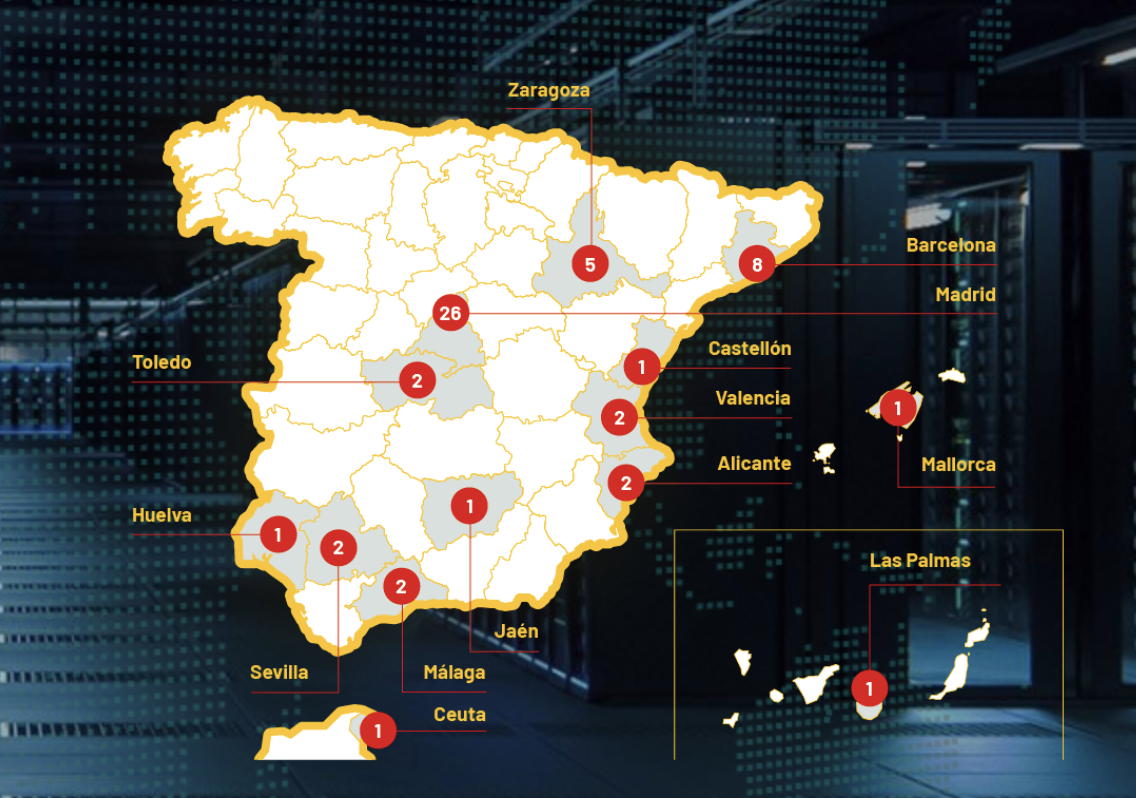
Spanish Data Center Ecosystem
Spanish Data Center Association
Here we see a tension that we also recognize in other participatory processes: when citizens enter the picture too late, their ability to influence outcomes is drastically reduced. Participating in a project when investments have already been committed, permits have been granted, and key decisions have already been made can turn participation into an exercise in validation rather than decision-making. In the case of data centers, this asymmetry is even greater due to the technical complexity of the projects, the difficulty in accessing comparable information, and the speed at which investments are moving forward.
That is why we are interested in viewing these conflicts not merely as environmental or technological disputes, but as problems of democratic design. The strategic litigation emerging in Aragón and other regions shows what happens when prior institutional mechanisms prove insufficient: the courts become one of the few available spaces to demand information, challenge procedures, and set limits. But it also raises another question: What democratic institutions do we need so that these discussions can take place before the conflict reaches the courts?
Story of Us: When Digital Infrastructure Becomes a Territorial Issue
In Aragón, Ecologistas en Acción has filed an administrative appeal with the High Court of Justice of Aragón to halt the expansion of Amazon Web Services data centers. The organization explicitly frames this as a strategic litigation against the Aragón Plan of General Interest (PIGA), which authorizes five AWS expansions in the region. The appeal is supported by Ecologistas en Acción Aragón, the neighborhood movements TuNubeSecaMiRío and No a los centros de datos Aragón, university researchers, the UNESCO Chair in Sustainable Human Development, and other associations.
One of their main demands is a basic one: to know how much water these infrastructure projects will actually consume. Specific data remains difficult to obtain, although we do know that in 2025, AWS requested a 48% increase in water availability for its data centers in Aragón. This case highlights a recurring paradox in the expansion of digital infrastructure: decisions capable of committing a region’s essential resources for decades can move forward without the affected communities having sufficient information to assess their consequences.
The lawsuit seeks to set a precedent for future data centers. We are, of course, seeking to halt the project and curb the abuse of mechanisms such as the Plan of General Interest for Aragon (PIGA), which constitute a violation of public participation and democratic planning. Privileges such as those granted by the PIGA cannot be awarded to projects that suffer from such a severe lack of transparency as that of Amazon Web Services. The government of Aragón is playing the role of a “Mr. Marshall” and handing over the region’s land and resources to a large multinational corporation. For all these reasons and more, we oppose this PIGA and hope that this project—which is extremely harmful to Aragón—does not come to fruition
Every new data center requires electricity, water, land, network connections, and, often, new associated energy infrastructure. The problem isn’t just how much each facility consumes, but what happens when dozens of them are concentrated in certain areas and begin to compete for resources that are already limited.
Electricity helps illustrate this shift in scale. In 2022, before the rapid expansion of generative artificial intelligence, data centers already accounted for between 1.8% and 2.6% of the European Union’s electricity demand. The average percentage, however, masks significant regional concentrations: in Ireland, it already accounted for 18% of national electricity consumption. Projections also point to strong growth over the course of this decade, driven in particular by the new computing demands of artificial intelligence.
Something similar happens with water. European data centers could require around 90 million cubic meters annually, primarily to cool equipment and support associated energy processes. The strain becomes particularly problematic when this demand is concentrated in regions subject to recurring droughts or water stress. The European Commission’s own Joint Research Center identifies Aragón as one of Europe’s future hubs for data centers and, at the same time, as a region vulnerable to water scarcity.
It is precisely this concentration that transforms what appears to be a technical issue into a political and territorial decision. Evaluating each data center in isolation can obscure the cumulative effect of multiple projects on the same power grid, the same watershed, or the same region. And if the infrastructure needed to power them—such as substations, cooling systems, power plants, or energy transmission networks—is processed through different procedures, the combined impact may disappear administratively even though it continues to exist in practice.
Compounding this fragmentation is an information problem. European regulations are beginning to require data on electricity consumption, water use, refrigerants, and the use of waste heat, but the available metrics remain incomplete and difficult to compare. The Joint Research Center warns that large technology companies publish insufficient information, use different indicators, or present aggregated figures that make it difficult to determine the actual impact of a specific facility in the region where it operates.
That is why the conflict in Aragon cannot be understood solely as local opposition to Amazon. The question it raises is much broader: How can a community deliberate on the costs and benefits of infrastructure when it lacks the necessary information to do so?
Strategic Litigation as a Tool for Citizens
In fact, in various countries, environmental organizations, local communities, and public-interest groups are turning to the courts to challenge a permitting model that tends to evaluate each data center as a standalone facility, even though its impacts depend on much broader systems: power grids, power plants, substations, cooling systems, and shared water resources.
These lawsuits are not necessarily directed against all digital infrastructure. What they challenge is how decisions are made, what information is used, and on what scale their impacts are assessed. The various cases highlight at least four key lessons:
1) The importance of taking action before impacts become irreversible. In Rovaltain, France, the Grenoble Administrative Court suspended in July 2026 the construction permit for a large-scale artificial intelligence data center proposed by Sesterce in Alixan. The judge found serious doubts regarding the legality of the authorization, particularly due to the absence of an environmental impact study and potential urban planning conflicts. The significance of the case lies not only in the suspension of the project, but also in the timing of the decision: judicial review intervenes before construction creates a situation that would be difficult to reverse.
2) Impacts cannot be assessed in isolation from the local context. In Cerrillos, Chile, residents and the city council challenged the environmental permit for a Google data center planned for the Santiago metropolitan area. In 2024, the Second Environmental Court partially overturned the approval and ordered that part of the assessment be redone to incorporate the effects of climate change on water availability. The litigation thus forced authorities to move beyond simply considering the facility’s declared water consumption and to ask what that consumption means in a region experiencing drought and pressure on the aquifer. Google ultimately withdrew the proposal and announced that it would be redesigned.
3) The need to prevent impacts from being fragmented administratively. Ireland offers several particularly relevant examples because data centers already place a considerable burden on its electrical grid. In Ennis, residents and environmental organizations jointly challenged the permits for a data center and its substation, arguing that its emissions and compatibility with the country’s climate obligations had not been adequately considered. In Newastle, Dublin, another legal action has drawn attention to the power plant associated with a data center complex. Both cases raise the same issue: assessing only the building itself can obscure a significant portion of its impact if the electricity, substations, or backup generation are treated as separate projects.
4) Declaring infrastructure to be strategic does not eliminate the obligation to justify its impacts. In Iver, Buckinghamshire, the organizations Foxglove and Global Action Plan filed a judicial review challenging the approval of a hyperscale data center covering approximately 72,000 square meters. The British government had approved the project despite local opposition and without requiring a full environmental assessment. In 2026, the government itself acknowledged a serious error in its reasoning and agreed that the permit should be revoked. The case challenges an increasingly common premise: that the strategic or critical nature of digital infrastructure can be used to undermine the environmental or democratic safeguards that accompany its authorization.
5) When numerous projects are concentrated in the same area, public opposition can force a shift from debating individual facilities to questioning the regional strategy as a whole. In Scotland, strong opposition to new data centers has led the government to strengthen oversight of facilities exceeding 50 MW and has even sparked debate over a possible temporary moratorium. This case shows that properly evaluating each project individually may not be enough: when the accumulation of such projects transforms the use of water, energy, and land, the question becomes whether a region wants to become a major data processing hub, under what conditions, and with what democratically agreed-upon limits.
Taken together, these cases do more than just call specific projects into question. They broaden the scope of what must be considered politically relevant before authorizing digital infrastructure. They highlight the need to intervene before impacts become irreversible; to evaluate each project within its climate and territorial context; to prevent fragmentation between data centers and the energy infrastructure that supports them; to subject declarations of strategic interest to scrutiny; and, when projects accumulate in a single territory, to initiate a preliminary discussion about the development model that such concentration is producing.
In this sense, the conflict is no longer solely environmental or urban planning-related. It forces us to ask a more fundamental question: Who decides that a territory should become a strategic hub for digital infrastructure, and through what democratic process are its boundaries established?
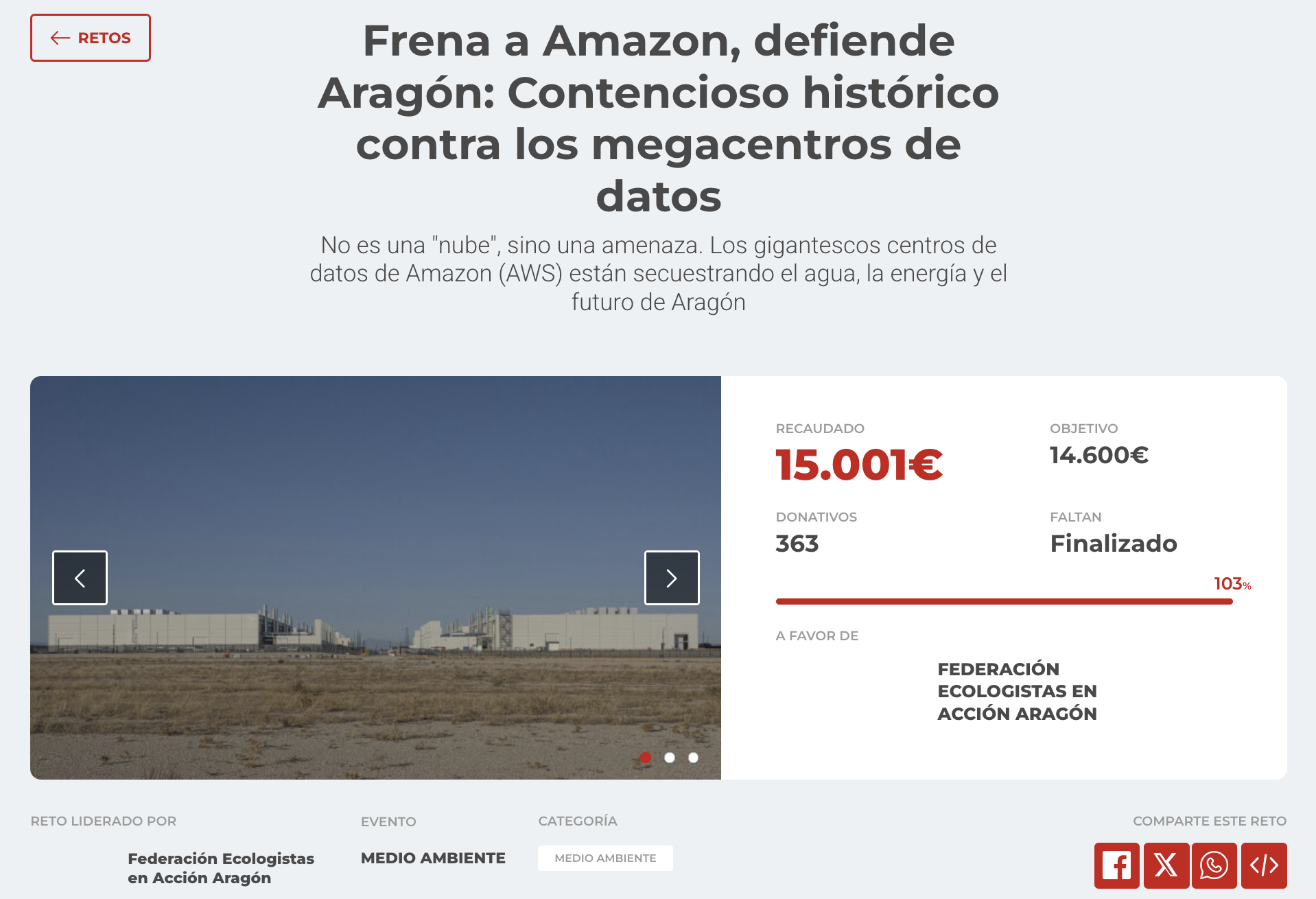
The case in Aragon clearly illustrates this reactive logic. The first legal action against the AWS expansion required raising 15,000 euros in three months under the slogan “Stop Amazon, Defend Aragon” to cover the costs of the proceedings. Such mobilization can partially level the playing field in court, but it does not resolve the underlying democratic deficit: Why was it necessary to go to court to discuss issues that could have been raised before the expansion was authorized?
Strategic litigation can correct abuses, demand transparency, and halt decisions when ordinary mechanisms fail. But it cannot replace a space where society can discuss in advance what infrastructure it needs, what limits should be imposed, and what costs it considers acceptable. The challenge, therefore, is not to choose between litigation and participation, but to connect the oversight capacity offered by the former with deliberative mechanisms capable of intervening before alternatives have disappeared.
Story of Now: From Reactive Litigation to Strategic Deliberation
Strategic litigation is proving that it can open significant cracks in decisions that would otherwise move forward with little public oversight. It can force government agencies to justify why a project serves the public interest, demand more comprehensive environmental assessments, challenge the fragmentation of impacts across different cases, and request information that was previously unavailable. But it has one obvious limitation: it intervenes when a large part of the decision has already been made.
Therefore, the challenge is not to replace litigation, but to shift part of that capacity for scrutiny to an earlier stage. If we know that certain infrastructure projects can commit significant amounts of water, energy, and land for decades, public deliberation should not begin when the conflict arises, but before the main alternatives have been ruled out.
Here, we propose viewing strategic litigation and mini-publics as two parts of the same democratic architecture. Litigation would serve as a mechanism for oversight and protection when government agencies fail to fulfill their obligations or when decisions violate rights and procedures. Mini-publics, on the other hand, would allow for intervention when it is still possible to discuss what should be done, under what conditions, and what limits should be established.
In practice, this could take the form of a Citizens’ Assembly on Digital Infrastructure linked to the planning and authorization processes for large data centers. The goal would not be to organize an open consultation at the end of the process, but rather to initiate a deliberative process before fundamental decisions are finalized. A sample of citizens selected through a civic lottery could work over several sessions with verified data on water and electricity consumption, land use, employment, taxation, emissions, associated energy infrastructure, and future growth scenarios.
The first condition of this process must be the right to know. Companies and government agencies should provide comparable information on the anticipated impacts of each facility and, above all, on their cumulative effects on the region. Deliberation can hardly be democratic if some stakeholders are aware of the actual needs for water, energy, or future expansion, while others must resort to freedom of information requests or legal proceedings to uncover them. When uncertainties or contradictory data exist, these should be explicitly incorporated into the process, rather than concealed under the guise of technical certainty.
Nor should the assembly limit itself to listening to presentations by experts. It should be able to question the project’s premises. Is all the planned computing capacity necessary? Why must it be located in that area? What alternatives exist? What are the acceptable limits for water or energy consumption? What happens if several projects are carried out simultaneously? What resources must be protected even if that reduces investment? Deliberation would thus begin before accepting the proposed infrastructure as inevitable.
This also requires broadening the range of participants in the production of knowledge. Alongside independent experts in energy, water, climate, and digital infrastructure, project developers, the relevant government agencies, researchers, environmental organizations, economic actors, and communities in the affected areas should be involved. The goal would not be to eliminate conflicts of interest, but rather to make them visible and open to discussion, allowing different positions to be scrutinized under more balanced conditions in terms of information and time.
The outcome of the mini-public forum would also need to be formally incorporated into the administrative process. Its recommendations could establish authorization conditions, consumption limits, transparency obligations, territorial compensation measures, monitoring mechanisms, or even criteria for determining when a project should not be approved. The government would retain decision-making authority but would be required to respond publicly to the recommendations and justify any decision that deviates from them.
The project would not end with the approval. Data on actual water and energy consumption, compliance with commitments, jobs created, and territorial impacts should remain public and subject to review. A citizen-led or independent body could conduct periodic monitoring and initiate new reviews when conditions change significantly. In this way, public participation would no longer be a one-time event but would become an integral part of the infrastructure’s governance throughout its entire life cycle.

Momento de la votación
Asamblea Ciudadana para el Clima (2022)
We can call this combination strategic deliberation: intervening precisely where alternatives still exist and linking that deliberation to mechanisms capable of producing institutional consequences. It is not a matter of adding participation to a project that has already been decided, but rather of incorporating democratic capacity at the very moments when it is determined what infrastructure will be built, what resources it may use, and what obligations it must assume.
Aragón could become a particularly relevant testing ground for this model. The lawsuit against the AWS expansion is already bringing to light what ordinary procedures failed to resolve: the need for information, cumulative assessment, and a public discussion about the limits of infrastructure. The next question is whether we need to wait for the next lawsuit to have that conversation.
So, what do we do?
Could Aragón become the place to test a different approach to decision-making regarding AI infrastructure?
At Platoniq, we want to continue exploring how to combine citizen deliberation, public access to data, and accountability mechanisms in decisions about digital infrastructure. If you’re working with affected communities, government agencies, research institutions, environmental organizations, or in the field of technology governance, we’d like to hear about the tools and experiences that could be part of this model.